
Resource library
Explore our complete library of resources including blogs, benchmarks, research papers, and more.

Data 2.0 and the research era of AI data
Announcing Snorkel’s $350M fundraise to build the frontier lab for AI data.


Terminal-Bench 4.0: Why Continuous Benchmarks Require Continuous QA


Grok 4.5 Testing Results: How SpaceXAI’s New Model Performs on Real Professional Work


Why coding agents need better data, evals, and environments

Closing the Evaluation Gap in Agentic AI
Announcing a $3M commitment to launch Open Benchmarks Grants

Why Frontier Agents Fail Real Engineering Work: Two Terminal-Bench 3.0 Task Deep Dives


Building FinQA: An Open RL Environment for Financial Reasoning Agents


The science of rubric design


During this research talk, you’ll see how you can achieve higher model performance from foundation models such as CLIP.

During this research talk, you’ll learn about Bonito, a novel open-source model for generating task-specific training datasets for instruction tuning.

During this research talk, you’ll see how follow-up differential descriptions (FuDD) can enhance zero-shot image classification by tailoring class descriptions for each dataset.
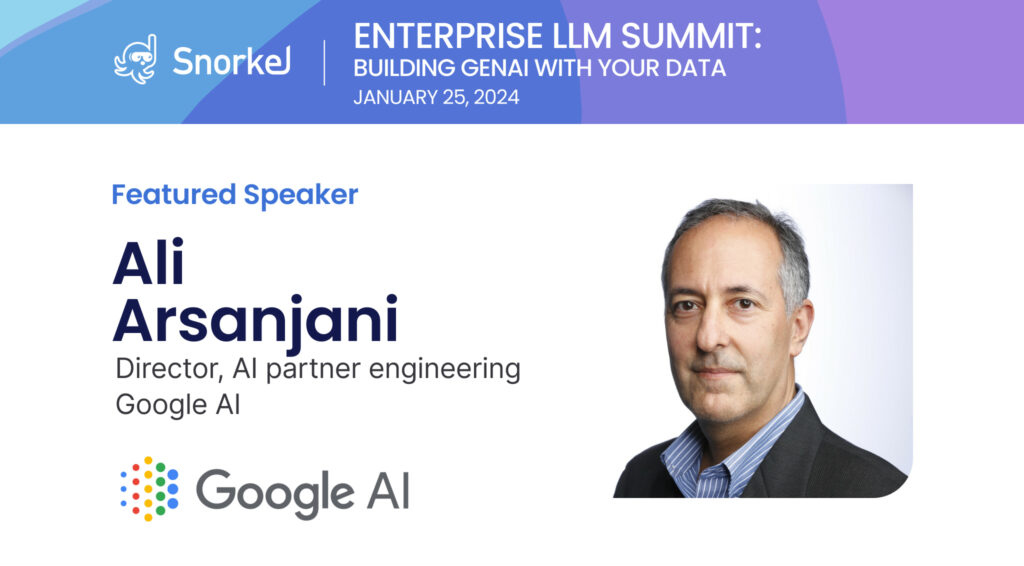
Snorkel’s Paroma Varma and Google’s Ali Arsenjani discus the role of data in the development and implementation of LLMs.

We’re excited to announce Snorkel Custom to help enterprises cross the chasm from flashy chatbot demos to real production AI value.

Snorkel AI placed a model at the top of the AlpacaEval leaderboard. Here’s how we built it, and how it changed AlpacaEval’s metrics.

As Snorkel AI prepares to build better enterprise LLM evaluations, we spoke with Yifan Mail from Stanford’s CRFM HELM project.

A customer wanted an llm system for complex contract question answering tasks. We helped them build it—beating the baseline by 64 points.

See how they were able to label millions of images in months vs. years and improve the accuracy of their models by 20+ points.

