resources

Resource library

Explore our complete library of resources including blogs, benchmarks, research papers, and more.

Image for Data 2.0 and the research era of AI data
Blog

Data 2.0 and the research era of AI data

Announcing Snorkel’s $350M fundraise to build the frontier lab for AI data.

September 22, 2026
Image for Terminal-Bench 4.0: Why Continuous Benchmarks Require Continuous QA
Blog

Terminal-Bench 4.0: Why Continuous Benchmarks Require Continuous QA

Announcing a $3M commitment to launch Open Benchmarks Grants
August 28, 2026
Image for Grok 4.5 Testing Results: How SpaceXAI’s New Model Performs on Real Professional Work
Blog

Grok 4.5 Testing Results: How SpaceXAI’s New Model Performs on Real Professional Work

Announcing a $3M commitment to launch Open Benchmarks Grants
July 8, 2026
Image for Why coding agents need better data, evals, and environments
Blog

Why coding agents need better data, evals, and environments

Announcing a $3M commitment to launch Open Benchmarks Grants
May 11, 2026
Image for Closing the Evaluation Gap in Agentic AI
Blog

Closing the Evaluation Gap in Agentic AI

Announcing a $3M commitment to launch Open Benchmarks Grants

February 11, 2026
Image for Why Frontier Agents Fail Real Engineering Work: Two Terminal-Bench 3.0 Task Deep Dives
Blog

Why Frontier Agents Fail Real Engineering Work: Two Terminal-Bench 3.0 Task Deep Dives

Announcing a $3M commitment to launch Open Benchmarks Grants
August 24, 2026
Image for Building FinQA: An Open RL Environment for Financial Reasoning Agents
Blog

Building FinQA: An Open RL Environment for Financial Reasoning Agents

Announcing a $3M commitment to launch Open Benchmarks Grants
March 30, 2026
Image for The science of rubric design
Blog

The science of rubric design

Announcing a $3M commitment to launch Open Benchmarks Grants
September 11, 2025
Image for Benchtalks #3: We taught AI everything except how to learn
Blog

Benchtalks #3: We taught AI everything except how to learn

Featuring Parth Asawa (Continual Learning Bench)

June 25, 2026
of
Type: All Types
Sort: Newest
Is Free Self-Alignment Possible?
Aligning pretrained language models (LMs) is a complex and resource-intensive process, often requiring access to large amounts of ground-truth preference data and substantial compute. Are these costs necessary? That is, it is possible to align using only inherent model knowledge and without additional training? We tackle this challenge with ALIGNEZ, a novel approach that uses (1) self-generated preference data and (2) representation editing to provide nearly cost-free alignment. During inference, ALIGNEZ modifies LM representations to reduce undesirable and boost desirable components using subspaces identified via self-generated preference pairs. Our experiments reveal that this nearly cost-free procedure significantly narrows the gap...
Research Paper
Is Free Self-Alignment Possible?

Aligning pretrained language models (LMs) is a complex and resource-intensive process, often requiring access to large amounts of ground-truth preference data and substantial compute. Are these costs necessary? That is, it is possible to align using only inherent model knowledge and without additional training? We tackle this challenge with ALIGNEZ, a novel approach that uses (1) self-generated preference data and…

Sep 18, 2024 •

D. Adila, et al.

Learn more about Is Free Self-Alignment Possible?
If CLIP Could Talk: Understanding Vision-Language Model Representations Through Their Preferred Concept Descriptions
"Recent works often assume that VisionLanguage Model (VLM) representations are based on visual attributes like shape. However, it is unclear to what extent VLMs prioritize this information to represent concepts. We propose Extract and Explore (EX2), a novel approach to characterize important textual features for VLMs. EX2 uses reinforcement learning to align a large language model with VLM preferences and generates descriptions that incorporate the important features for the VLM. Then, we inspect the descriptions to identify the features that contribute to VLM representations. We find that spurious descriptions have a major role in VLM representations despite providing no helpful...
Research Paper
If CLIP Could Talk: Understanding Vision-Language Model Representations Through Their Preferred Concept Descriptions

“Recent works often assume that VisionLanguage Model (VLM) representations are based on visual attributes like shape. However, it is unclear to what extent VLMs prioritize this information to represent concepts. We propose Extract and Explore (EX2), a novel approach to characterize important textual features for VLMs. EX2 uses reinforcement learning to align a large language model with VLM preferences and…

Sep 18, 2024 •

R. Esfandiarpoor, et al.

Learn more about If CLIP Could Talk: Understanding Vision-Language Model Representations Through Their Preferred Concept Descriptions
Found in the Middle: Calibrating Positional Attention Bias Improves Long Context Utilization
Large language models (LLMs), even when specifically trained to process long input contexts, struggle to capture relevant information located in the middle of their input. This phenomenon has been known as the lost-in-themiddle problem. In this work, we make three contributions. First, we set out to understand the factors that cause this phenomenon. In doing so, we establish a connection between lost-in-the-middle to LLMs’ intrinsic attention bias: LLMs exhibit an U-shaped attention bias where the tokens at the beginning and at the end of its input receive higher attention, regardless of their relevance. Second, we mitigate this positional bias through...
Research Paper
Found in the Middle: Calibrating Positional Attention Bias Improves Long Context Utilization

Large language models (LLMs), even when specifically trained to process long input contexts, struggle to capture relevant information located in the middle of their input. This phenomenon has been known as the lost-in-themiddle problem. In this work, we make three contributions. First, we set out to understand the factors that cause this phenomenon. In doing so, we establish a connection…

Sep 18, 2024 •

C. Hsieh, et al.

Learn more about Found in the Middle: Calibrating Positional Attention Bias Improves Long Context Utilization
Exploring the Potential of Large Language Models in Neurology, Using Neurologic Localization as an Example
Research Paper
Exploring the Potential of Large Language Models in Neurology, Using Neurologic Localization as an Example
Sep 18, 2024 •

CC. Chiang, et al.

Learn more about Exploring the Potential of Large Language Models in Neurology, Using Neurologic Localization as an Example
Evaluating Language Model Context Windows: A “Working Memory” Test and Inference-time Correction
Large language models are prominently used in real-world applications, often tasked with reasoning over large volumes of documents. An exciting development in this space is models boasting extended context capabilities, with some accommodating over 2 million tokens. Such long context model capabilities remain uncertain in production systems, motivating the need to benchmark their performance on real world use cases. We address this challenge by proposing SWiM, an evaluation framework that addresses the limitations of standard tests. Testing the framework on eight long context models, we find that even strong models such as GPT-4 and Claude 3 Opus degrade in performance...
Research Paper
Evaluating Language Model Context Windows: A “Working Memory” Test and Inference-time Correction

Large language models are prominently used in real-world applications, often tasked with reasoning over large volumes of documents. An exciting development in this space is models boasting extended context capabilities, with some accommodating over 2 million tokens. Such long context model capabilities remain uncertain in production systems, motivating the need to benchmark their performance on real world use cases. We…

Sep 18, 2024 •

A. Dsouza, et al.

Learn more about Evaluating Language Model Context Windows: A “Working Memory” Test and Inference-time Correction
Characterizing the limitations of using diagnosis codes in the context of machine learning for healthcare
Importance: Diagnostic codes are commonly used as inputs for clinical prediction models, to create labels for prediction tasks, and to identify cohorts for multicenter network studies. However, the coverage rates of diagnostic codes and their variability across institutions are underexplored. Objective: Primary objective was to describe lab- and diagnosis-based labels for 7 selected outcomes at three institutions. Secondary objectives were to describe agreement, sensitivity, and specificity of diagnosis-based labels against lab-based labels. Methods: This study included three cohorts: SickKidsPeds from The Hospital for Sick Children, and StanfordPeds and StanfordAdults from Stanford Medicine. We included seven clinical outcomes with lab-based definitions:...
Research Paper
Characterizing the limitations of using diagnosis codes in the context of machine learning for healthcare

Importance: Diagnostic codes are commonly used as inputs for clinical prediction models, to create labels for prediction tasks, and to identify cohorts for multicenter network studies. However, the coverage rates of diagnostic codes and their variability across institutions are underexplored. Objective: Primary objective was to describe lab- and diagnosis-based labels for 7 selected outcomes at three institutions. Secondary objectives were…

Sep 18, 2024 •

LL Guo, et al.

Learn more about Characterizing the limitations of using diagnosis codes in the context of machine learning for healthcare
A Systematic Review of Testing and Evaluation of Healthcare Applications of Large Language Models (LLMs)
Studies rarely use real patient care data for LLM evaluation. Administrative tasks such as generating provider billing codes and writing prescriptions are understudied. Natural Language Processing (NLP)/Natural Language Understanding (NLU) tasks like summarization, conversational dialogue, and translation are infrequently explored. Accuracy is the predominant dimension of evaluation, while fairness, bias and toxicity assessments are neglected. Evaluations in specialized fields, such as nuclear medicine and medical genetics are rare. Current LLM assessments in healthcare remain shallow and fragmented. To draw concrete insights on their performance, evaluations need to use real patient care data across a broad range of healthcare and NLP/NLU...
Research Paper
A Systematic Review of Testing and Evaluation of Healthcare Applications of Large Language Models (LLMs)

Studies rarely use real patient care data for LLM evaluation. Administrative tasks such as generating provider billing codes and writing prescriptions are understudied. Natural Language Processing (NLP)/Natural Language Understanding (NLU) tasks like summarization, conversational dialogue, and translation are infrequently explored. Accuracy is the predominant dimension of evaluation, while fairness, bias and toxicity assessments are neglected. Evaluations in specialized fields, such…

Sep 18, 2024 •

S. Bedi, et al.

Learn more about A Systematic Review of Testing and Evaluation of Healthcare Applications of Large Language Models (LLMs)
A Multi-Center Study on the Adaptability of a Shared Foundation Model for Electronic Health Records
Background: Foundation models hold promise for transforming artificial intelligence (AI) in healthcare by providing modular components that are easily adaptable to downstream healthcare tasks, making AI development more scalable and cost-effective. Foundation models for structured electronic health records (EHR), trained on coded medical records from millions of patients, demonstrated benefits including increased performance with fewer training labels, and improved robustness to distribution shifts. However, questions remain on the feasibility of sharing these models across different hospitals and their performance for local task adaptation. Objective: This multi-center study examined the adaptability of a recently released structured EHR foundation model (FMSM), trained...
Research Paper
A Multi-Center Study on the Adaptability of a Shared Foundation Model for Electronic Health Records

Background: Foundation models hold promise for transforming artificial intelligence (AI) in healthcare by providing modular components that are easily adaptable to downstream healthcare tasks, making AI development more scalable and cost-effective. Foundation models for structured electronic health records (EHR), trained on coded medical records from millions of patients, demonstrated benefits including increased performance with fewer training labels, and improved robustness…
Sep 18, 2024 •

LL Guo, et al.

Learn more about A Multi-Center Study on the Adaptability of a Shared Foundation Model for Electronic Health Records
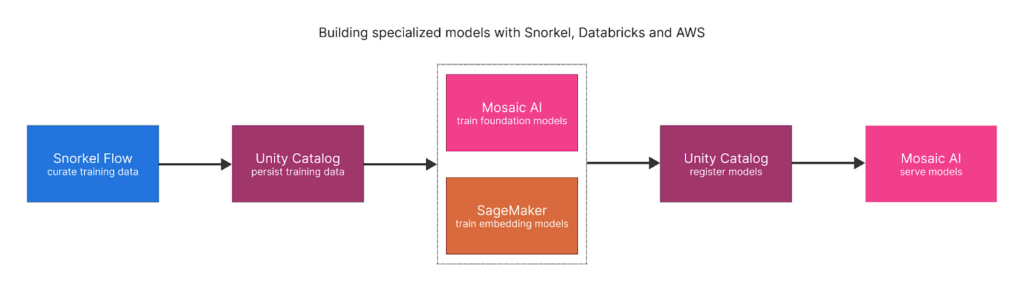
How a global financial services company built a specialized AI copilot accurate enough for production
Blog
How a global financial services company built a specialized AI copilot accurate enough for production

Learn how Snorkel, Databricks, and AWS enabled the team to build and deploy small, specialized, and highly accurate models which met their AI production requirements and strategic goals.

Sep 09, 2024 •
Learn more about How a global financial services company built a specialized AI copilot accurate enough for production
1 … 18 19 20 … 70
Image

Join our newsletter

For expert advice, the latest research, and exclusive events.
By submitting this form, I acknowledge I will receive email updates from Snorkel AI, and I agree to the Terms of Use and acknowledge that my information will be used in accordance with the Privacy Policy.