
Resource library
Explore our complete library of resources including blogs, benchmarks, research papers, and more.

Data 2.0 and the research era of AI data
Announcing Snorkel’s $350M fundraise to build the frontier lab for AI data.


Terminal-Bench 4.0: Why Continuous Benchmarks Require Continuous QA


Grok 4.5 Testing Results: How SpaceXAI’s New Model Performs on Real Professional Work


Why coding agents need better data, evals, and environments

Closing the Evaluation Gap in Agentic AI
Announcing a $3M commitment to launch Open Benchmarks Grants


Why Frontier Agents Fail Real Engineering Work: Two Terminal-Bench 3.0 Task Deep Dives


Building FinQA: An Open RL Environment for Financial Reasoning Agents


The science of rubric design



Learn about the obstacles faced by data scientists in LLM evaluation and discover effective strategies for overcoming them.


Snorkel AI and AWS are partnering to help enterprises build, deploy, and evaluate custom, production-ready AI models. Learn how.

What is AI data development? AI data development includes any action taken to convert raw information into a format useful to AI.

In this webinar, we’ll explain how enterprise AI/ML teams use Snorkel Flow’s evaluation framework to measure GenAI performance based on SME guidelines and feedback, identify areas of improvement and take corrective action to reach production accuracy requirements.
In this demo, learn how Snorkel AI powers efficient data labeling and management for LLM fine-tuning, natively integrating with Amazon Bedrock and SageMaker for seamless, end-to-end development of specialized models.

Discover highlights of Snorkel AI’s first annual SnorkelCon user conference. Explore Snorkel’s programmatic AI data development achievements.
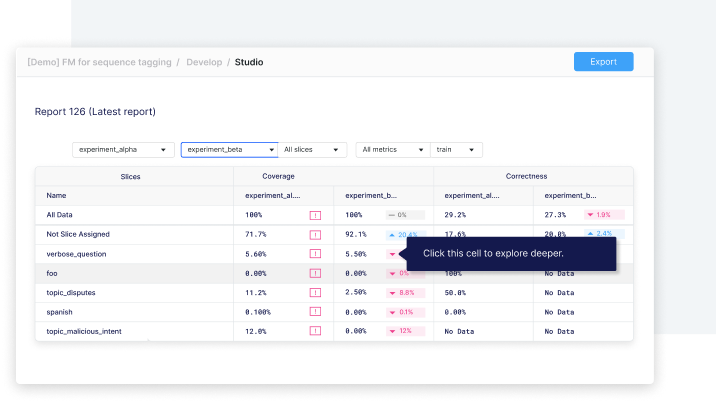
Snorkel AI has made building production-ready, high-value enterprise AI applications faster and easier than ever. The 2024.R3 update to our Snorkel Flow AI data development platform streamlines data-centric workflows, from easier-than-ever generative AI evaluation to multi-schema annotation.

We aim to help our customers get GenAI into production. In our 2024.R3 release, we’ve delivered some exciting GenAI evaluation results.

