


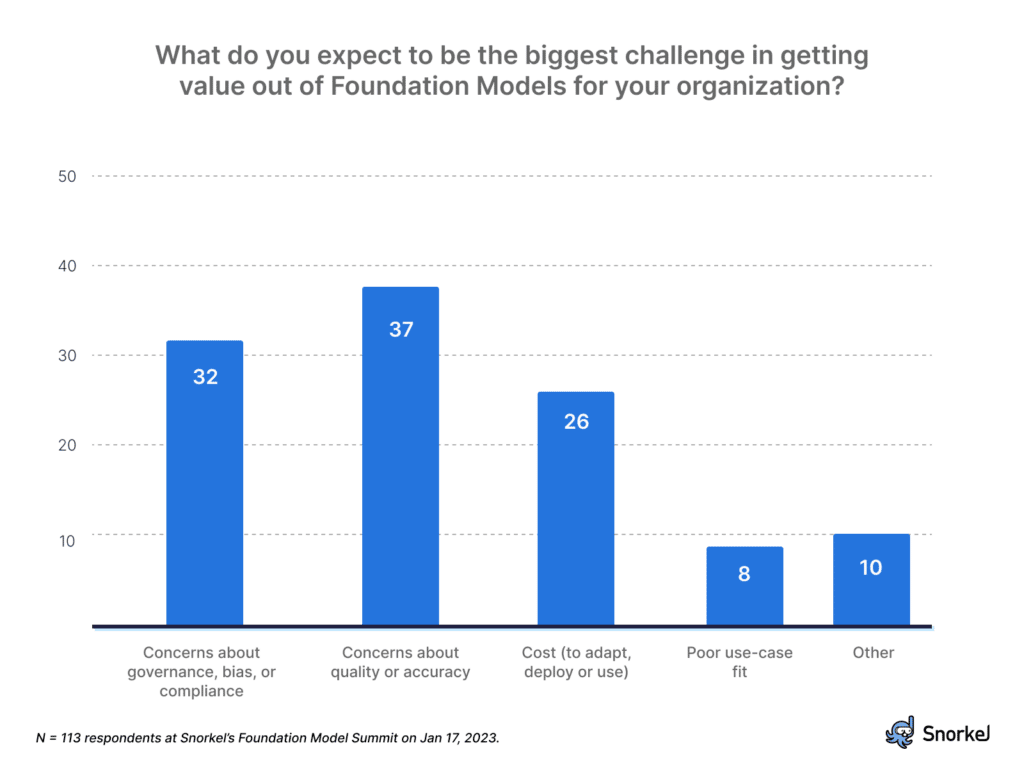
Most poll respondents at Snorkel AI’s recent Foundation Model Virtual Summit named questionable accuracy as the biggest barrier preventing them from getting organizational value from Foundation Models.
The January 17 Summit brought together 12 presenters and more than 600 attendees at 10 virtual sessions. Between presentations, we polled attendees on how they expect Foundation Models to fit into their organizations. The results point to broad enthusiasm for Foundation Models (FMs) and Large Language Models (LLMs). But hesitations endure.
Attendees ranked concerns about governance and cost closely behind quality. Notably, just 8% of respondents said they expected “poor use case fit” to block them from using FMs, which suggests that almost all respondents expect to make use of FMs at some point, and tracks closely with other poll results from the same event.
Poll results: top uses and challenges of FMs
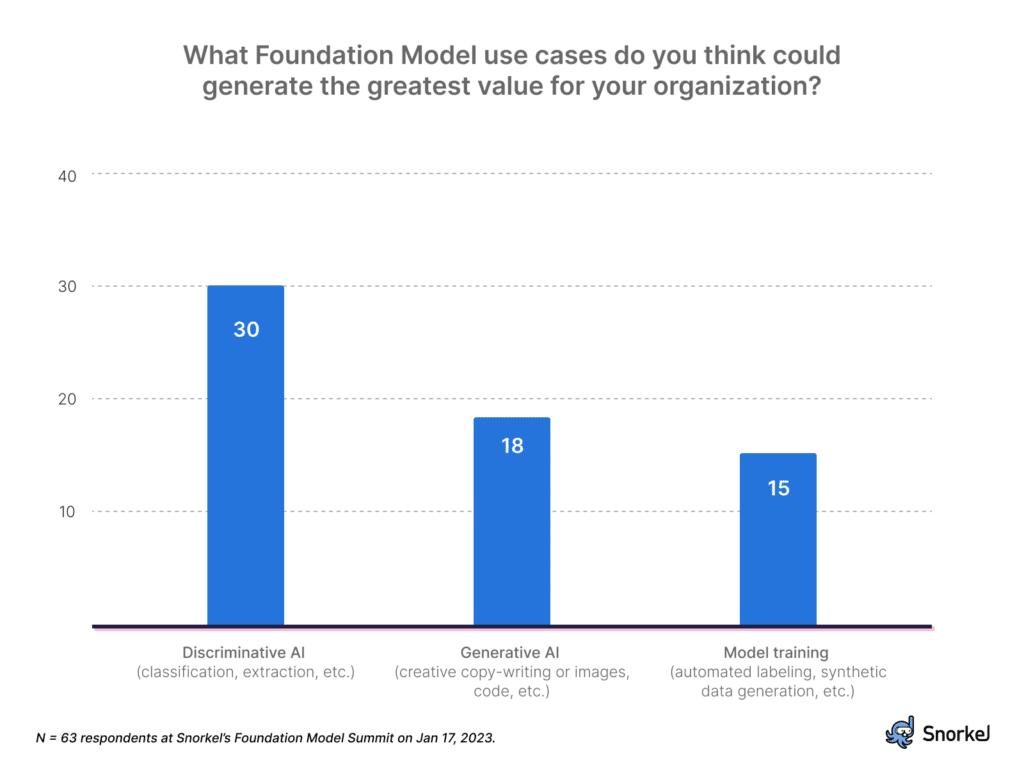
Foundation Models will likely provide their greatest value through classification and extraction tasks, according to nearly half of the respondents to our poll—though realizing that value may have to wait. Enterprises generally require a high rate of accuracy to deploy new classification or extraction tools into production, and the results of our first question show that respondents aren’t sure FMs are ready to clear that bar.
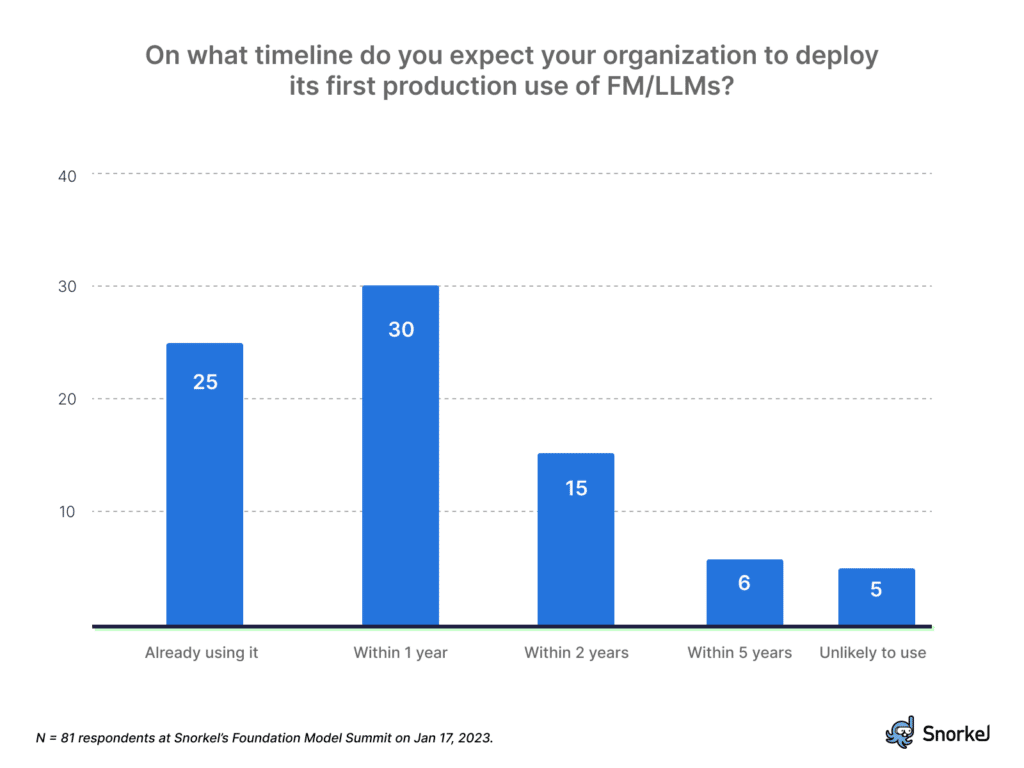
We also asked attendees to estimate the timeline by which they expected their organization to deploy its first production use of FMs or LLMs. Of those who responded, only 6% said they were unlikely to use Foundation Models in their business. That mirrors the 8% who named “poor use-case fit” as the reason FMs may not yield value for their organization, but there is some nuance between these questions.
Deploying a new resource doesn’t necessarily mean that the organization will get value out of it. Many experiments fail, but it appears that most of our attendees are eager to experiment. Nearly two-thirds of respondents expected their organization to launch its first production use of FMs in the next year—if it hasn’t already.
Final thoughts
The above results are subject to meaningful error due to our small sample size and significant sampling bias; the respondents all chose to attend a half-day educational session about Foundation Models and answer our optional questions.
However, given that our attendees spanned many industries, including technology, healthcare, and financial services, we think these results—flawed as they are—indicate substantial interest in this new era of artificial intelligence and machine learning.
Like our attendees, we at Snorkel are excited about Foundation Models. Our researchers have published papers on how to get the greatest value from FMs, and our engineers have integrated FM-enabled features into the Snorkel Flow platform.
To see our new Foundation Model features in action, register now for a Snorkel Flow live demo on February 16, 2023.

Matt Casey
Data Science Content Lead
Matt Casey leads content production at Snorkel AI. In prior roles, Matt built machine learning models and data pipelines as a data scientist. As a journalist, he produced written and audio content for outlets including The Boston Globe and NPR affiliates.
Recommended articles
View all articles

Frontier AI is Accelerating. Open Benchmarks Need to Keep Up.
Today, we’re excited to announce that we are expanding our Open Benchmarks Grants by 10x to a $30M commitment, to support researchers, domain experts, and open-source teams pushing the frontier of robust, open frontier AI evaluation. The expanded program includes: Through our initial $3M commitment to Open Benchmarks Grants (OBG) and our broader research collaborations, we’ve partnered with the teams
October 7, 2026
•

MedPAIR: Measuring Whether Physicians and AI Agree on What Matters in Medical QA
Yuexing Hao presents MedPAIR, a dataset comparing which sentences physicians and LLMs find relevant in clinical questions. Humans and LLMs agree on only 50 to 60% of relevance labels.
October 2, 2026
•
Snorkel Team

RL environments for LLM agents: Design, rewards, and validation
TLDR: An agent, by definition, can take actions and is more than just a language model. The model is only one part of the system, and is only one element that you are training. The environment determines what the agent can observe, what it can change, which actions are available, and what behavior receives a reward. For a coding agent,
September 28, 2026
•
,

