Category

Research

Snorkel AI emerged from a research project, and we remain closely connected to the research community. Students and professors associated with the Snorkel project continue to publish academic papers that push the field forward, and the Snorkel AI research team integrates the most promising of those ideas into our platform.
Our picks

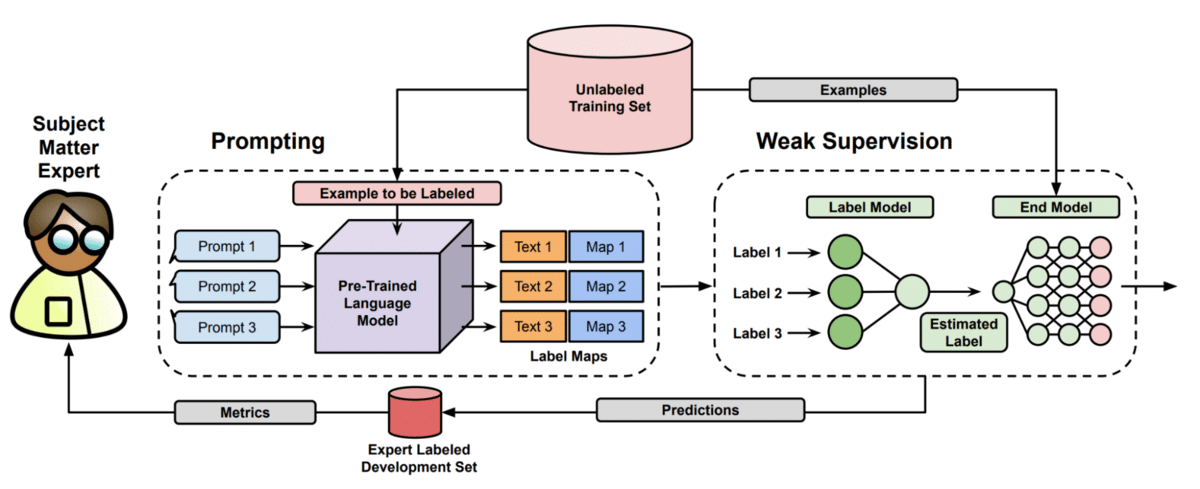
Image for Getting better performance from foundation models (with less data)
Getting better performance from foundation models (with less data)
August 4, 2023
Fred Sala
Image for Snorkel AI researchers present 18 papers at NeurIPS 2023
Snorkel AI researchers present 18 papers at NeurIPS 2023
The Snorkel AI team will present 18 research papers and talks at the 2023 Neural Information Processing Systems (NeurIPS) conference from December 10-16. The Snorkel papers cover a broad range of topics including fairness, semi-supervised learning, large language models (LLMs), and domain-specific models. Snorkel AI is proud of its roots in the research community and endeavors to remain at the forefront
October 31, 2023
Team Snorkel
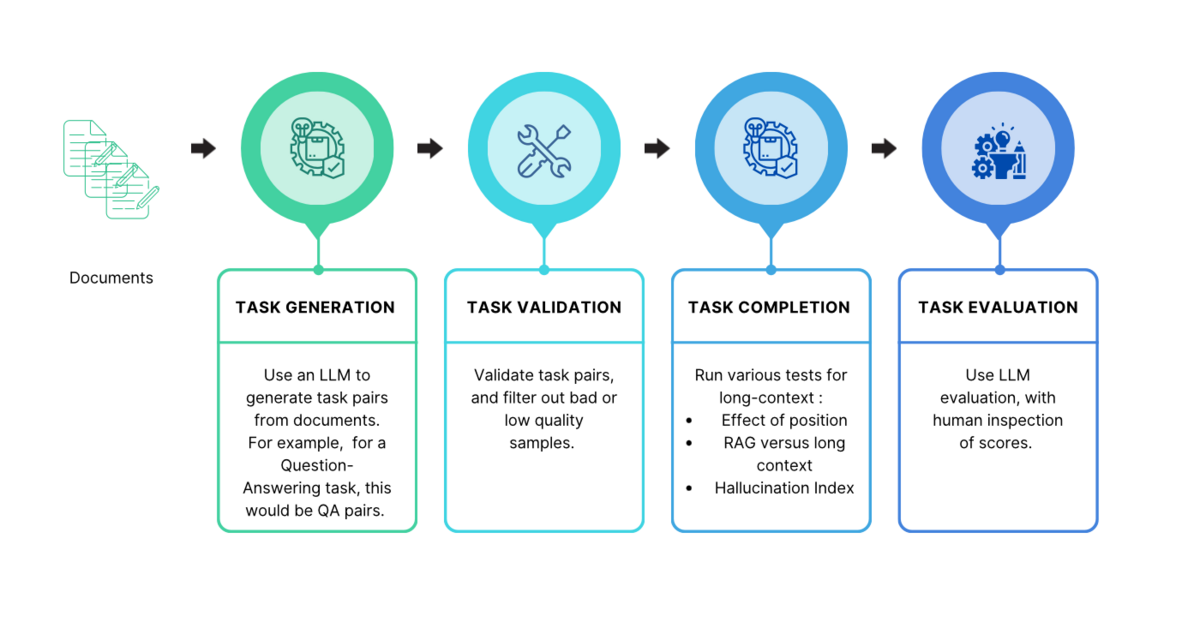
Image for Long context models in the enterprise: benchmarks and beyond
Long context models in the enterprise: benchmarks and beyond
Snorkel researchers devised a new way to evaluate long context models and address their “lost-in-the-middle” challenges with mediod voting.
June 6, 2024
Amanda Dsouza

All articles on Research

judgment-bench
JudgmentBench: Comparing Rubric and Preference Evaluation for Quality Assessment
At our latest Snorkel AI Reading Group, Russell Yang (AI Engineering Fellow at Stanford Law) stopped by our San Francisco office to present JudgmentBench: Comparing Rubric and Preference Evaluation for Quality Assessment. As AI models improve at open-ended tasks, the field faces a harder problem: how to measure quality in domains where ground truth is contested. Two paradigms dominate: rubric-based
June 18, 2026
Snorkel Team
benchmarks-3-axis
The Art and Science of Building AI Benchmarks That Shape the Field
Vincent Sunn Chen spoke at AI Engineer London about what it actually takes to build AI benchmarks that move the field forward, not just measure it. The throughline is an asymmetry that keeps showing up across deployments and the 150+ proposals reviewed for the Open Benchmarks Grants: agent capabilities are climbing fast, but the ability to measure those agents with
June 16, 2026
Snorkel Team
Image
Cua-Bench: benchmarking computer-use agents on professional software
TL;DR We built a benchmark of 25 expert-authored KiCad schematic-editing tasks and ran a frontier computer-use agent against them. The headline numbers: 1. Why build a computer-use benchmark for electrical engineering? Most computer-use benchmarks today live in the same handful of apps: web browsers, file managers, generic productivity suites. Those evaluations are useful, but they share a structural weakness —
June 15, 2026
Armin Parchami
,
Zhengyang (Jason) Qi
collab-gym-thumbnail
Collaborative Gym: A Framework for Enabling and Evaluating Human-Agent Collaboration
At our latest Snorkel AI Reading Group, Yijia Shao (Stanford NLP) stopped by our San Francisco office to present Collaborative Gym: A Framework for Enabling and Evaluating Human-Agent Collaboration. As LLM agents get better at automating tasks on their own, a large class of real-world problems still needs a human in the loop – for their preferences, their domain expertise, or simply for control.
June 4, 2026
Snorkel Team
Image
Benchtalks #2: The future of coding benchmarks
For our second Benchtalks, the series dedicated to the researchers building the measurement toolkits that frontier labs hill-climb on, Snorkel AI co-founder Vincent Sunn Chen sat down with John Yang, a Stanford PhD student and creator of the SWE-bench franchise, SWE-smith, CodeClash, and most recently ProgramBench. Highlights More on ProgramBench: See the benchmark and the upcoming leaderboard at programbench.com. More from John Yang: Publications and writing at john-b-yang.github.io. Snorkel
June 3, 2026
Vincent Sunn Chen
Image
Code World Models and AutoHarness for LLM Agents
At our latest Snorkel AI Reading Group, Carter Wendelken of Google DeepMind walked us through two related papers he presented at ICLR: Code World Models for General Game Playing and AutoHarness: Improving LLM Agents by Automatically Synthesizing a Code Harness. Both ask the same question from opposite ends: when you want an LLM to act reliably in a complex, possibly
May 14, 2026
David Burch
coding-agents-eval
Why coding agents need better data, evals, and environments
Coding agents have moved from tab-complete to teammate. They autonomously inspect repositories, edit files, run commands, diagnose failures, and work through multi-step engineering tasks. That creates a harder reliability problem. A model that only suggests code is easy for a human to evaluate. A coding agent refactoring your repository and testing its own changes is much harder to supervise –
May 11, 2026
Justin Bauer
Mayee chen olmix paper cover
Understanding Olmix: A Framework for Data Mixing Throughout Language Model Development
At our latest Snorkel AI Reading Group, Mayee Chen (Stanford, Hazy Research) stopped by our San Francisco office to walk us through Olmix: A Framework for Data Mixing Throughout LM Development — work she contributed to during her internship at Ai2 on OLMo 3. Olmix tackles one of the messiest, least-documented levers in LLM pre-training: how to set the ratios
May 1, 2026
David Burch
Benchmarks should shape the frontier, not just measure it-Image
Benchmarks should shape the frontier, not just measure it
Since launching the Open Benchmarks Grants, we’ve received more than 100 applications from academic groups and industry labs spanning a wide range of domains and capabilities. As the best benchmarks drive how the field allocates research effort, the bar for benchmarks has risen as well. Here, we share what’s now table stakes for useful benchmarks, and what separates the ones
April 7, 2026
Vincent Sunn Chen
Building the Benchmark Factory Banner
Benchtalks #1: Alex Shaw (Terminal-Bench, Harbor) – Building the Benchmark Factory
To kick off our inaugural Benchtalks, a series dedicated to the researchers building these measurement toolkits, Snorkel AI co-founder Vincent Sunn Chen sat down with Alex Shaw, Founding MTS at Laude Institute and co-creator of Terminal-Bench and Harbor. Highlights More on Terminal-Bench: See the leaderboard and the catalog of tasks at tbench.ai. Explore Harbor: Learn how to scale your agent
March 31, 2026
Vincent Sunn Chen
Building FinQA: An Open RL Environment for Financial Reasoning Agents Banner
Building FinQA: An Open RL Environment for Financial Reasoning Agents
TL;DR: We built FinQA — a financial question-answering environment with 290 expert-curated questions across 22 public companies, now available on OpenEnv. Agents use MCP tools to discover schemas, write constrained SQL queries, and answer multi-step questions from real SEC 10-K filings. Most open-source models struggle with this kind of multi-step tool use, and even frontier closed-source models, while more accurate,
March 30, 2026
Bhavishya Pohani
How Tool Discipline Let a 4B Model Outsmart a 235B Giant on Financial Tasks Image
How Tool Discipline Let a 4B Model Outsmart a 235B Giant on Financial Tasks
The Snorkel research team collaborated with the rLLM team at UC Berkeley on the Agentica project, using their open-source rLLM framework to fine-tune Qwen3-4B-Instruct-2507, delivering a model that beats Qwen3-235B-A22B on Snorkel AI’s expert-curated financial benchmarks – at 1/60th the size. A full breakdown of the results are published in the rLLM blog here. The key insight? Just focus on
February 18, 2026
Chris Glaze
Image
Coding agents don’t need to be perfect, they need to recover
Error analysis of 8 models on Agentic Coding tasks Successful completion of complex tasks doesn’t come from models being always right. It comes from models being resilient when things go wrong. To get a deeper understanding of model behavior in agentic environments, our team analyzed all of the errors found in the full traces of tasks from our Agentic Coding
February 13, 2026
Ramya Ramakrishnan
Closing the Evaluation Gap in Agentic AI Image
Closing the Evaluation Gap in Agentic AI
Today, AI is marked by a growing asymmetry: the excitement around agentic AI is real — backed by quantitative progress on model cards and genuine leaps forward, especially in coding. But ask individuals or enterprises where they feel ready to deploy agentic automation in high-stakes, domain-specific settings outside of coding… and you will find hesitation. The reason: our ability to
February 11, 2026
Vincent Sunn Chen
Image
SlopCodeBench: Measuring Code Erosion as Agents Iterate
SlopCodeBench reveals how AI coding agents degrade code quality over time—measuring “slop,” technical debt, and architectural erosion across iterations.
January 20, 2026
Kobie Crawford