
Resource library
Explore our complete library of resources including blogs, benchmarks, research papers, and more.

Data 2.0 and the research era of AI data
Announcing Snorkel’s $350M fundraise to build the frontier lab for AI data.


Terminal-Bench 4.0: Why Continuous Benchmarks Require Continuous QA


Grok 4.5 Testing Results: How SpaceXAI’s New Model Performs on Real Professional Work


Why coding agents need better data, evals, and environments

Closing the Evaluation Gap in Agentic AI
Announcing a $3M commitment to launch Open Benchmarks Grants


Why Frontier Agents Fail Real Engineering Work: Two Terminal-Bench 3.0 Task Deep Dives


Building FinQA: An Open RL Environment for Financial Reasoning Agents


The science of rubric design


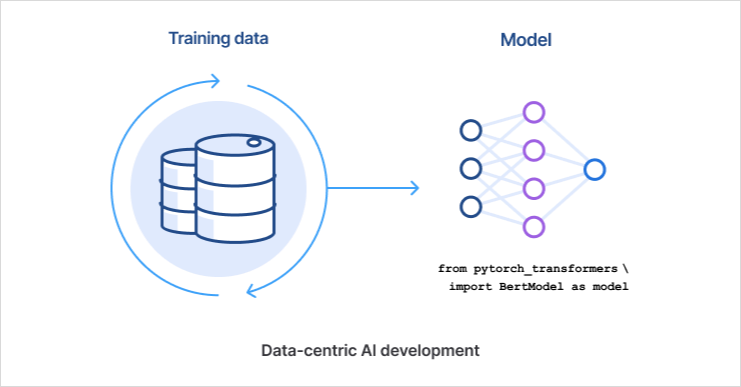
The founding team of Snorkel AI has spent over half a decade—first at the Stanford AI Lab and now at Snorkel AI—researching data-centric techniques to overcome the biggest bottleneck in AI: The lack of labeled training data. In this video Snorkel AI co-founder Paroma Varma gives an overview of the key principles of data-centric AI development. What is data-centric AI?…

Leveraging Snorkel Flow to extract critical data from annual quarterly reports (10-Ks) Introduction It can surprise those who have never logged into EDGAR how much information is available in annual reports from public companies. You can find tactical details like the names of senior leadership, top shareholders, and more strategic information like earnings, risk factors, and the company strategy and vision. Warren…
Showcasing Liger—a combination of foundation model embeddings to improve weak supervision techniques. Machine learning whiteboard (MLW) open-source series In this talk, Mayee Chen, a PhD student in Computer Science at Stanford University focuses on her work combining weak supervision and foundation model embeddings that improve two essential aspects of current weak supervision techniques. Check out the full episode here or…
An introduction to AI in cybersecurity with real-world case studies in a Fortune 500 organization and a government agency Despite all the recent advances in artificial intelligence and machine learning (AI/ML) applied to a vast array of application areas and use cases, success in AI in cybersecurity remains elusive. The key component to building AI/ML applications is training data, which…
A primer on active learning presented by Josh McGrath. Machine learning whiteboard (MLW) open-source series This video defines active learning, explores variants and design decisions made within active learning pipelines, and compares it to related methods. It contains references to some seminal papers in machine learning that we find instructive. Check out the full video below or on Youtube. Additionally, a…
Utilizing large language models as zero-shot and few-shot learners with Snorkel for better quality and more flexibility Large language models (LLMs) such as BERT, T5, GPT-3, and others are exceptional resources for applying general knowledge to your specific problem. Being able to frame a new task as a question for a language model (zero-shot learning), or showing it a few…

How can data-centric AI speeds your end-to-end healthcare AI development and deployment Healthcare is a field that is awash in data, and managing it all is complicated and expensive. As an industry, it benefits tremendously from the ongoing development of machine learning and data-centric AI. The potential benefits of AI integration in healthcare can be broken down into two categories:…
In this paper, accepted at ICLR 2022, Chris and team at Stanford outline a new principled evaluation framework for comparing slice detection methods, then introduce a new technique motivated by our discoveries that outperforms existing methods by double digits.
This paper describes TAGLETS, a system built to study techniques for automatically exploiting all three types of data and creating high-quality, servable classifiers

