

We develop methods, benchmarks, and training systems that turn expert data into frontier AI
building benchmarks and collaborating with


Featured research

Senior SWE-bench built by Snorkel with Princeton University and UW-Madison

Continual Learning Bench: Evaluating agents that adapt and improve over time

Learning from Less: Measuring the Effectiveness of RLVR in Low Data Compute Regimes

Agents' Last Exam: Challenge and measure AI agents on economically valuable and real-world tasks

SlopCodeBench: A community benchmark measuring code erosion

Harvey’s BigLaw Bench: Research

Terminal-Bench 2.0: Raising the bar for AI agent evaluation

Benchmarking Agents in Insurance Underwriting Environments

Agentic Coding benchmark: Evaluating AI Models on complex, real-world coding tasks
Vision and impact
We help labs advance frontier models by working with domain experts to design and build complex, realistic datasets that drive model performance.

Benchmarking & Evaluation
Build benchmarks that define and advance the AI frontier

Scaling Subject Matter Expertise
Define how subject matter experts encode their knowledge into data

RL, Training, & Data Valuation
Drive dataset development based on feedback from RL and model training
Community and open science
Open benchmarks, conversations, and research for real-world AI performance.

Open Benchmarks Grants
Backed by a $30M commitment, Open Benchmarks Grants funds new benchmarks, red-teams existing ones to find weaknesses, and supports researchers through a fellowship.

Benchtalks

Reading Group
DEEP RESEARCH Expertise
Technical advisors and distinguished affiliates


Browse research blogs and academic papers

Research recap: Ontology-driven weak supervision for clinical entity classification in electronic health records (EHRs) In this post, I have summarized the research published in this academic paper, Ontology-driven weak supervision for clinical entity classification in electronic health records by Jason Fries et al. This paper was published in Nature Communications in 2021.Problem statement Electronic health records (EHR) contain a rich…

Learning about the challenges and opportunities behind deep neural networks In this talk, Assistant Professor in Computer Science Sharon Li shares some exciting work about uncovering the unknowns of deep neural networks. She also shares some exciting challenges and opportunities in this domain. If you would like to watch Sharon’s presentation, we have included it below, or you can find…

The future of data-centric AI talk series In this talk, Assistant Professor of Biomedical Data Science at Stanford University, James Zou, discusses the work he and his team have been doing from a data-centric perspective to trustworthy and interpretable AI. If you would like to watch James’ presentation, we have included it below, or you can find the entire event…

The future of data-centric AI talk series Don’t miss the opportunity to gain an in-depth understanding of data-centric AI and learn best practices from real-world implementations. Connect with fellow data scientists, machine learning engineers, and AI leaders from academia and industry with over 30 virtual sessions. Save your seat at The Future of Data-Centric AI. Happening on August 3-4, 2022….

30+ sessions by 40+ speakers in 2 action-packed days Last year we organized The Future of Data-Centric AI conference to explore the shift from model-centric to data-centric AI. Speakers included researchers and industry experts such as Andrew Ng (Landing AI), Anima Anandkumar (NVIDIA), Chris Re (Stanford AI Lab), Michael DAndrea (Genentech), Skip McCormick (BNY Mellon), Imen Grida Ben Yahia (Orange)…

Constructing labeling functions (LFs) is at the heart of using weak supervision. We often think of these labeling functions as programmatic expressions of domain expertise or heuristics. Indeed, much of the advantage of weak supervision is that we can save time—writing labeling functions and applying them to data at scale is much more efficient compared to hand-labeling huge numbers of…

Powerful resources to leverage as labeling functions In this post, we’ll use the COVID-FACT dataset to demonstrate how to use existing resources as labeling functions (LFs), to build a fact-checking system. The COVID-FACT dataset contains 4086 claims about the COVID-19 pandemic; it contains claims, evidence for the claims, and contradictory claims refuted by the evidence. The evidence retrieval is formulated…

This post showcases a panel discussion on the academic and industry perspectives of ethical AI, which was moderated by Director of Federal Strategy and Growth, Alexis Zumwalt, Fouts Family Early Career Professor and Lead of Ethical AI (NSF AI Institute AI4OPT), Georgia Institute of Technology, Swati Gupta, Chief Data Officer, Department of the Navy, Thomas Sasalsa, Senior Manager of Responsible…
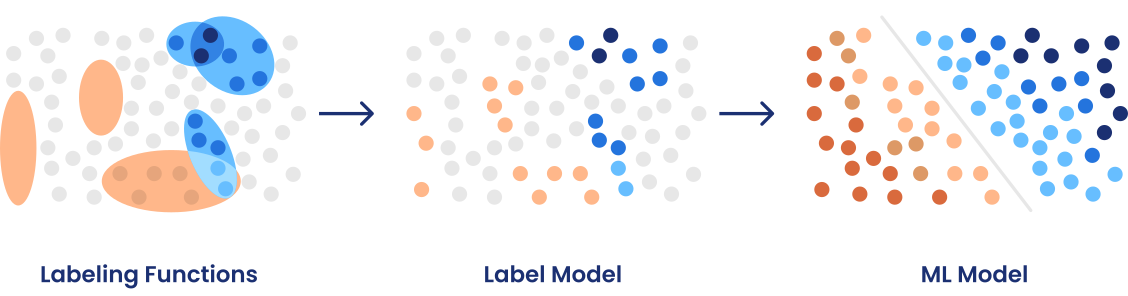
The founding team of Snorkel AI has spent over half a decade—first at the Stanford AI Lab and now at Snorkel AI—researching programmatic labeling and other techniques for breaking through the biggest bottleneck in AI: the lack of labeled training data. This research has resulted in the Snorkel research project and 150+ peer-reviewed publications. Snorkel’s programmatic labeling technology has been…

