LLM distillation isolates task-specific LLM performance and mirrors it in a smaller format—creating faster and cheaper performance.
February 13, 2024
•
Matt Casey
AI alignment made simple: innovative solutions for businesses
AI alignment ensures that AI systems align with human values, ethics, and policies. Here’s a primer on how developers can build safer AI.
June 27, 2024
•
Fred Sala
RAG: LLM performance boost with retrieval-augmented generation
Retrieval-augmented generation (RAG) enables LLMs to produce more accurate responses by finding and injecting relevant context. Learn how.
August 15, 2024
•
Matt Casey
All articles on Applied AI
Top-10 US bank uses AI/ML to triage loan documents based on risk exposure
To meet the requirements of unexpected regulatory changes brought on by the pandemic, a top-10 US bank needed to urgently adapt its underperforming model-centric artificial intelligence and machine learning development approach to a data-centric one. The team used Snorkel Flow to automatically classify thousands of loan documents and extract critical clauses in just 24 hours, saving loan managers thousands of hours of manual document review.
September 30, 2022
•
Nick Harvey
How Schlumberger uses Snorkel Flow to enhance proactive well management
Schlumberger is the world’s leading provider of technology and services for the energy industry, operating in over 120 countries. The company provides well maintenance and analytics services to the world’s biggest oil companies, and it believes that large-scale data analysis and artificial intelligence/machine learning will help them remain a leader in the market. One way they’ve been able to achieve this is by building their own AI application using Snorkel Flow to automatically extract geological entities and critical field data across a variety of document structures and report types they receive from their customers.
September 30, 2022
•
Nick Harvey
Introducing Continuous Model Feedback to drive rapid data quality improvement
Continuous Model Feedback, available in beta as part of the new Studio experience, is Snorkel Flow’s latest capabilities to make training data creation and model development more integrated, automated, and guided.
August 29, 2022
•
Molly Friederich
The Future of Data-Centric AI 2022 day 2 highlights
Snorkel AI just hosted the second day of The Future of Data-Centric AI conference 2022. Across 40+ sessions, 50+ Data scientists, ML engineers, and AI leaders came together to share insights, best practices, and research on adopting data-centric approaches with thousands of attendees from all around the world. Aarti Bagul, a Snorkel AI ML Solutions Engineer and one of the
August 5, 2022
•
Louis Bouchard
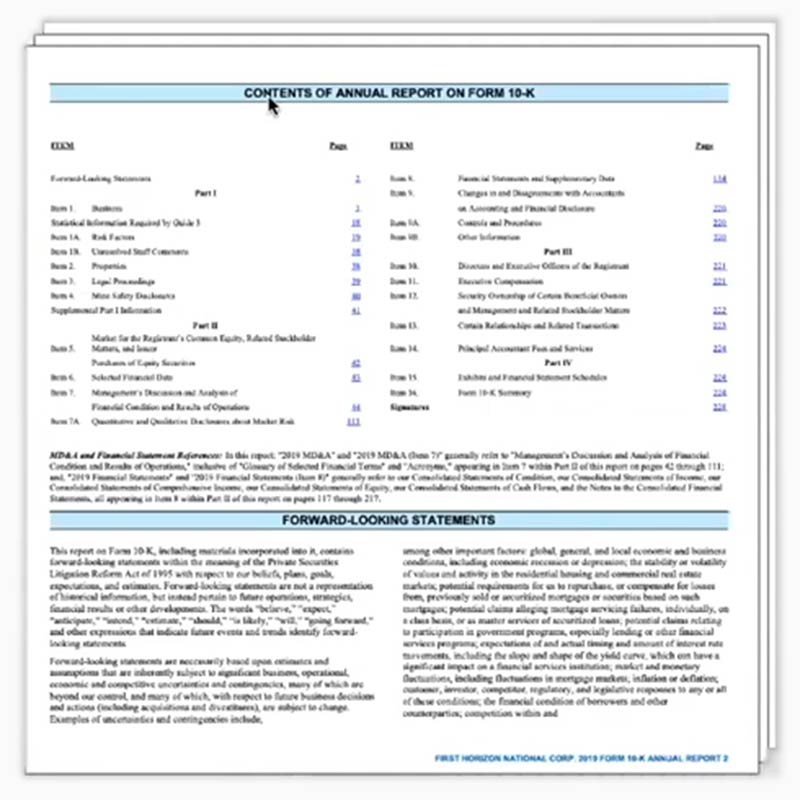
10-Ks information extraction case studies
Building NLP techniques to understand 10-Ks is time-consuming, costly, and challenging. In this post, Machine Learning Engineer, Aarti Bagul discusses three information extraction case studies on how banks around the world are building highly accurate NLP applications using Snorkel Flow’s AI platform. From retail banking to hedge fund investing, NLP is used across the financial industry. By processing and extracting
July 6, 2022
•
Team Snorkel
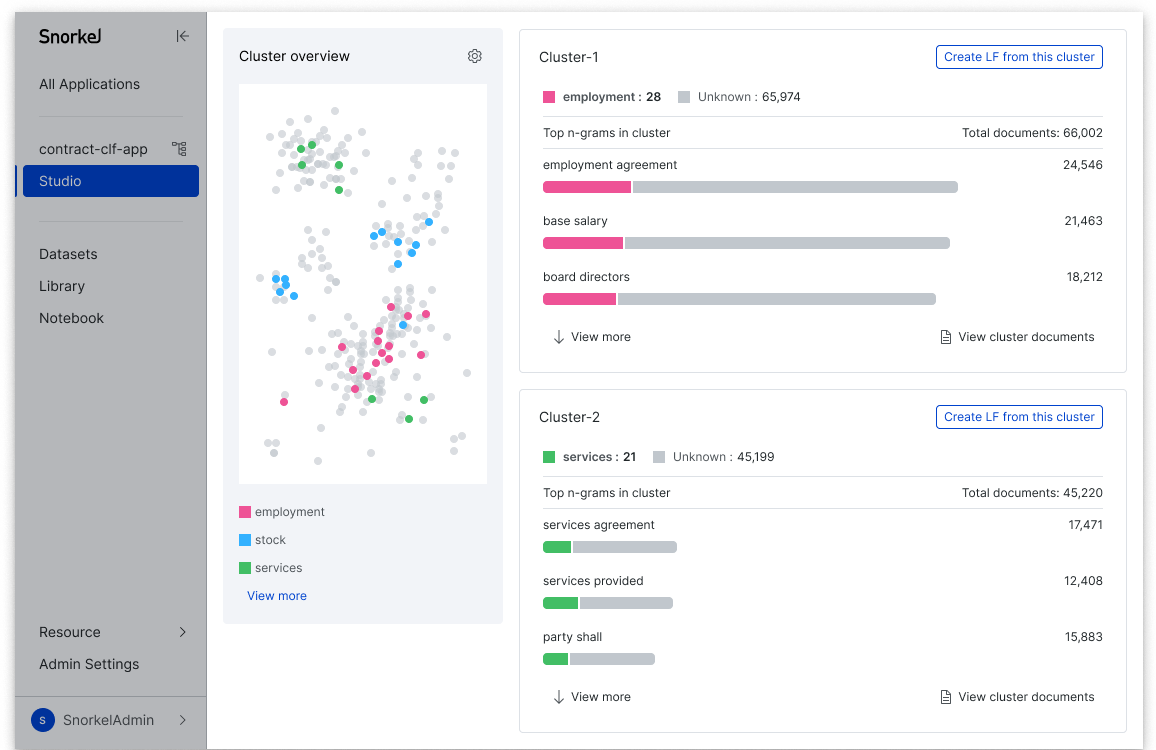
Introducing Cluster View: Instant data insight made actionable to speed AI development
Programmatic labeling moves a classic technique from interesting to high-impact So much of real-world AI development entails working with text data that’s messy — in fact, 80%+ of enterprise data is unstructured. And while state-of-the-art models get a lot of the glory, creating the training data that conveys what your model needs to learn is more often the biggest determiner of AI
June 30, 2022
•
Molly Friederich
Data-centric approaches to multi-label classification
AI systems are well-suited to tasks involving recognizing and predicting data patterns. Supervised classification systems categorize unseen data into a finite set of discrete classes by learning from millions of hand-labeled labeled sample points. These classifiers are powerful business tools – they automate document sorting, customer sentiment analysis, sales performance, and other distinct business problems. However, they also require an
June 29, 2022
•
Kanyes Thaker
Data annotation guidelines and best practices
What is data annotation? Data annotation refers to the process of categorizing and labeling data for training datasets. This process plays a critical role in preparing data for machine learning models, as high-quality training data enables more accurate predictions and insights. In order for a training dataset to be usable, it must be categorized appropriately and annotated for a specific
June 28, 2022
•
Anastassia Kornilova
Building AI models for financial document processing best practices
Highlighting the best practices for building and deploying AI models for financial document processing applications AI has massive potential in the financial industry. Building AI models to automate information extraction, fraud detection, and compliance monitoring can provide efficient and faster responses and support repurposing domain experts’ labor to more meaningful tasks. Developing AI models is not just about having models
June 15, 2022
•
Hoang Tran
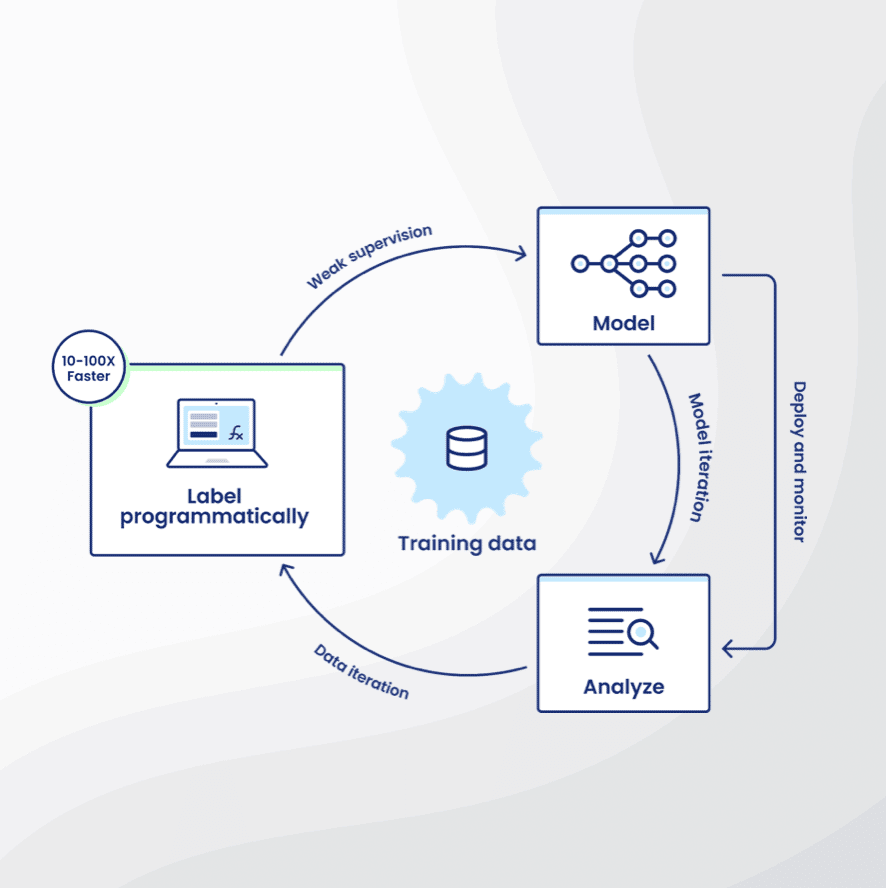
The benefits of programmatic labeling for trustworthy AI
The following post is based on a talk discussing the benefits of programmatic labeling for trustworthy AI, which was presented as part of the Trustworthy AI: A Practical Roadmap for Government event that took place this past April, with Snorkel AI Co-founder and Head of Technology, Braden Hancock. If you would like to watch Braden’s presentation, we have included it
June 9, 2022
•
Team Snorkel
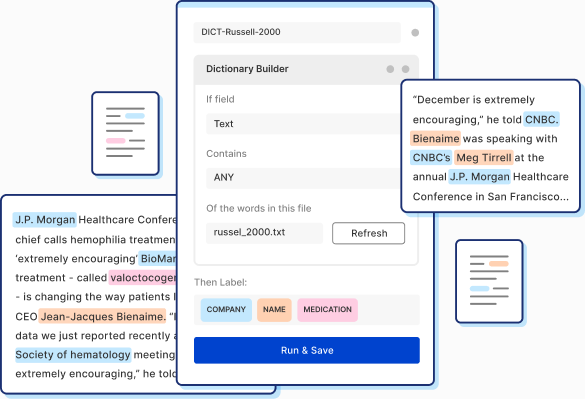
Named entity extraction and recognition with Snorkel Flow
If you were ever amazed at how Google accurately finds the answer to your question just by a few keywords, you’ve witnessed the power of named entity recognition (NER). By quickly and accurately identifying different entities in a sea of unstructured articles, like names of people, places, and organizations, the search engine can figure out each article’s main topics and
June 7, 2022
•
April Guo
Government keynote presentation by FBI CTO Gregory Ihrie
Gregory Ihrie is the Chief Technology Officer for the FBI, responsible for technology, innovation, and strategy. He also leads the FBI’s efforts in advancing the bureau’s management, policy, and governance of AI systems. Ihrie chairs the FBI’s Scientific Working Group on Artificial Intelligence, as well as the Department of Justice’s AI Committee of Interest. He is one of three officers
June 4, 2022
•
Team Snorkel
Snorkel AI FAQ
Browse through these FAQ to find answers to commonly raised questions about Snorkel AI, Snorkel Flow, and data-centric AI development. Have more questions? Contact us. Programmatic labeling Use cases 1. What is a labeling function? A Labeling Function (LF) is an arbitrary function that takes in a data point and outputs a proposed label or abstains. The logic used to
May 25, 2022
•
Team Snorkel
Event recap: Adopting trustworthy AI for government
We’re currently experiencing such a rapid AI revolution and adoption of technologies, ranging from autonomous cars to virtual assistants and robotic surgeries and so much more, making it challenging for our government agencies to keep up. Especially when adding AI technologies to the mix, it can be even harder to manage.The crucial adoption of trustworthy AI and its successful integration
May 23, 2022
•
Weak supervision
The founding team of Snorkel AI has spent over half a decade—first at the Stanford AI Lab and now at Snorkel AI—researching weak supervision (WS) and other techniques for breaking through the biggest bottleneck in AI: the lack of labeled training data. This research has resulted in the Snorkel research project and 150+ peer-reviewed publications. Snorkel’s technology which applies weak