


30+ sessions by 40+ speakers in 2 action-packed days
Last year we organized The Future of Data-Centric AI conference to explore the shift from model-centric to data-centric AI. Speakers included researchers and industry experts such as Andrew Ng (Landing AI), Anima Anandkumar (NVIDIA), Chris Re (Stanford AI Lab), Michael DAndrea (Genentech), Skip McCormick (BNY Mellon), Imen Grida Ben Yahia (Orange) and more. The conference garnered a surprising amount of interest and engagement. Over 1000+ data scientists and machine learning practitioners joined us to discuss how data-centric AI is used to build better AI faster.
So we’re putting together the conference again this year! And we want to invite you to join us to learn, discuss, and connect with individuals making AI practical by putting data-centric AI to use. This year we have 30+ sessions presented by 40+ speakers from some of the largest enterprises, leading AI companies, and notable academic institutions.
Details at a glance:
Date:
August 3 – 4, 2022
Time:
9am – 1pm PT / each day
Format:
Virtual and free
Register for free today
Data-centric AI is changing how AI is built
Traditionally, data science and machine learning teams have focused on a model-centric approach to building AI. With significant research and investment in the last few years, models have become increasingly complex and simultaneously more accessible. AI teams easily find code on GitHub that matches the model they want to build. They spend significant time on feature engineering, algorithm design, bespoke architecture design, etc.–iterating on and developing the model while treating the data that is used to train the model as a static artifact. This often results in spending significant effort to improve model performance marginally. But more importantly, the model-centric approach consumes AI teams’ time and effort on non-differentiating aspects of the AI development workflow.
Today, data used to train the ML models has become the arbiter of the success or failure of AI projects. With a data-centric approach to AI, teams spend more time gathering, labeling, and iterating on the training data treating it as a dynamic artifact. This results in accurate and fairer data and, in turn, higher-quality models
Learn more about data-centric AI
The Future of Data-Centric AI 2022
At this year’s conference, 40+ speakers from our customer base, global enterprises, startups, and academia will deliver rich industry insights, case studies, and research findings on novel techniques. Snorkel AI co-founder and CEO Alex Ratner will also share his vision for where data-centric AI is headed. There will be 30+ sessions on various topics related to challenges, solutions, and ideas to make AI practical. These include (but are not limited to):
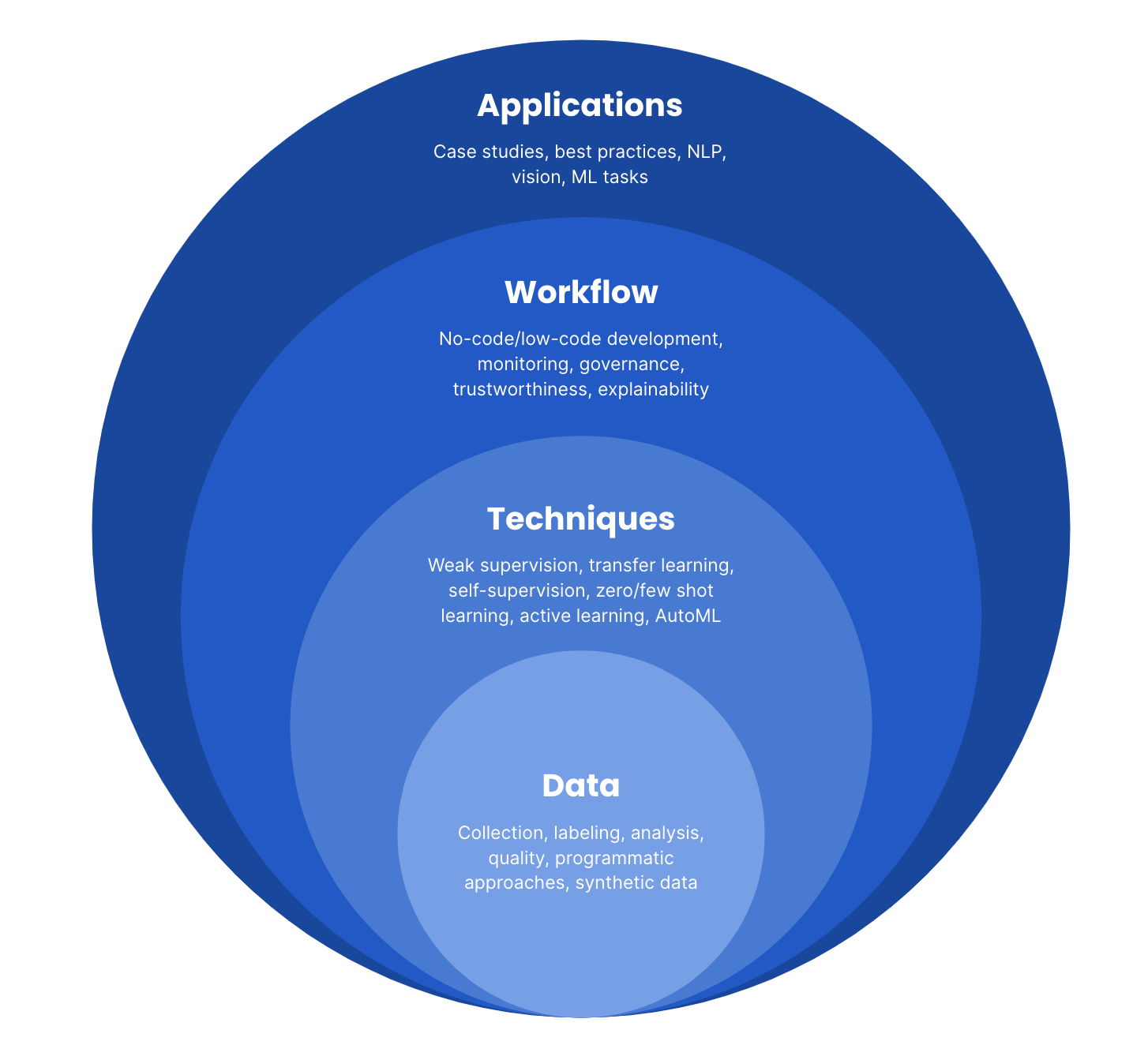 Topics discussed at The Future of Data-Centric AI 2022
Data-centric organizations share their challenges and success stories
Since 2019, Snorkel AI has worked with organizations such as BNY Mellon, Genentech, Memorial Sloan Kettering Cancer Center, Orange, and more, and several government agencies to apply data-centric AI using Snorkel Flow. Snorkel AI also continues to carry out fundamental research on data-centric AI techniques such as weak supervision, transfer, self-and semi-supervised, zero-shot learning, data augmentation, and synthetic data generation with our partners at Brown, MIT, Harvard, Stanford, and more. Organizations have witnessed 10-100x acceleration in building AI applications by adopting Snorkel Flow’s data-centric approaches.
40+ speakers from some of the world’s most advanced AI organizations such as Apple, Capital One, Citi, Genentech, Google, IDC, Ipsos, Keybank, LinkedIn, Meta, Memorial Sloan Kettering Cancer Center, McKinsey, Nvidia, Orange, Pinterest, Schlumberger, State Farm, Wells Fargo, Brown, ETH Zurich, Harvard, MIT, Stanford, and more will join us at the conference this year.
Join us to learn from our speakers about the challenges and success stories of employing data-centric AI workflows.
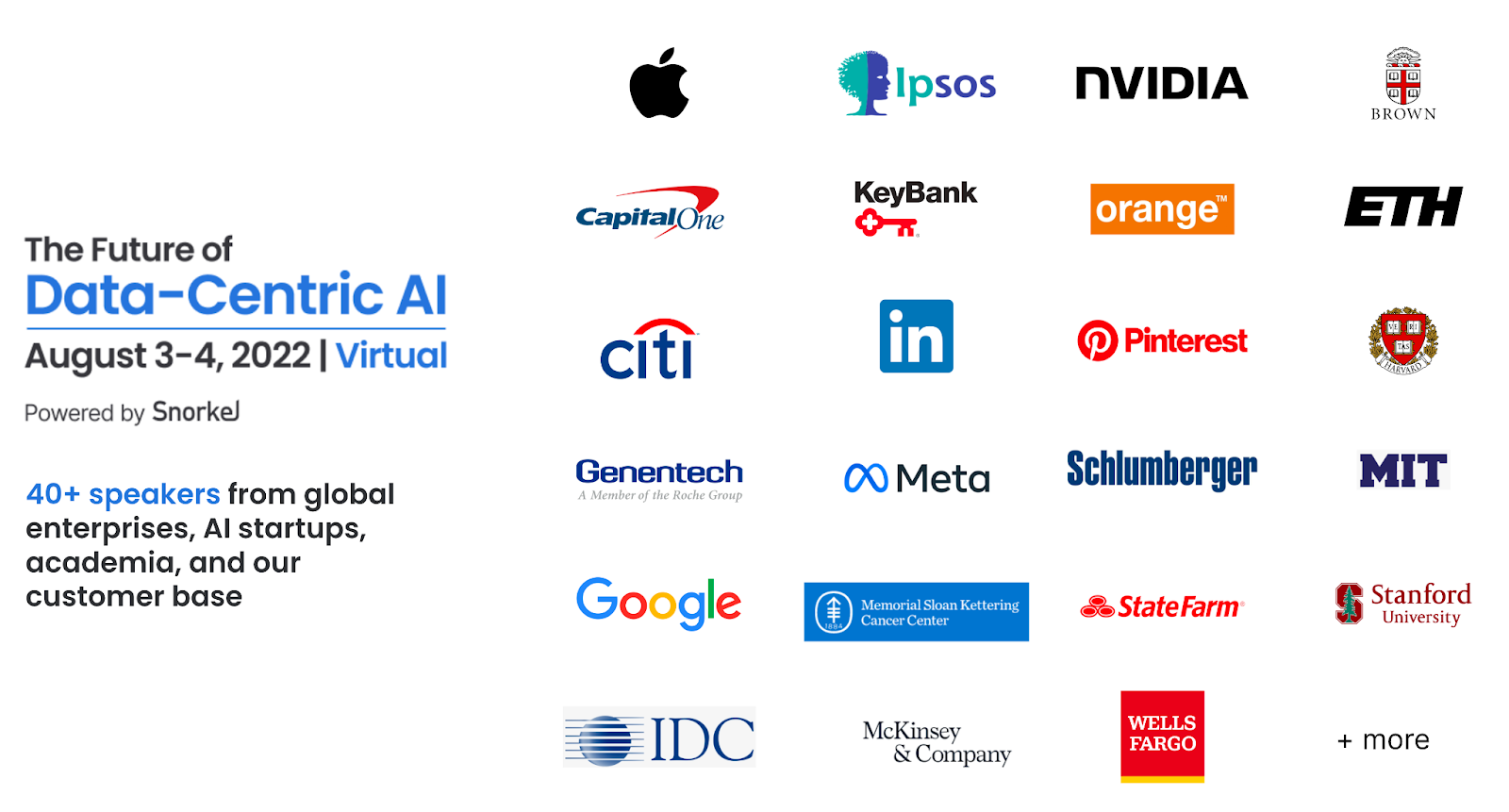 Speakers from some of the world’s most advanced AI organizations at The Future of Data-Centric AI
See the complete list of speakers
[New this year] Snorkel Flow workshop
This year we are adding a hands-on workshop dedicated to Snorkel Flow. At this workshop, you will learn how to build AI applications rapidly using a data-centric AI workflow, weak supervision, and programmatic labeling. Experts from Snorkel will introduce you to Snorkel Flow and walk you through an end-to-end process of data labeling, model training, and refinement.
Details at a glance:
Date:
August 2, 2022
Time:
9am – 11am PT
Format:
Virtual and free
Learn more and apply to reserve your spot
A reason to connect live
While all the sessions and the workshop are held virtually, we will be hosting an in-person social in the San Francisco Bay Area on August 3, 5 – 7 pm PT. So whether you are looking to connect your peers in data science and the AI/ML community or meet Snorkelers, join us.
As organizations across the globe spearhead their planning and strategies for next year, it’s the perfect time for AI professionals to explore data-centric AI and how to leverage it for business success.
Register for free today

Recommended articles
View all articles

Frontier AI is Accelerating. Open Benchmarks Need to Keep Up.
Today, we’re excited to announce that we are expanding our Open Benchmarks Grants by 10x to a $30M commitment, to support researchers, domain experts, and open-source teams pushing the frontier of robust, open frontier AI evaluation. The expanded program includes: Through our initial $3M commitment to Open Benchmarks Grants (OBG) and our broader research collaborations, we’ve partnered with the teams
October 7, 2026
•

MedPAIR: Measuring Whether Physicians and AI Agree on What Matters in Medical QA
Yuexing Hao presents MedPAIR, a dataset comparing which sentences physicians and LLMs find relevant in clinical questions. Humans and LLMs agree on only 50 to 60% of relevance labels.
October 2, 2026
•
Snorkel Team

RL environments for LLM agents: Design, rewards, and validation
TLDR: An agent, by definition, can take actions and is more than just a language model. The model is only one part of the system, and is only one element that you are training. The environment determines what the agent can observe, what it can change, which actions are available, and what behavior receives a reward. For a coding agent,
September 28, 2026
•
,

