


TLDR:
- An agentic RL environment is a closed loop of state, observations, actions, transitions, rewards, and resets.
- Interactive environments reveal tool use, recovery, constraint tracking, and verified state change that static outputs cannot fully measure.
- Reward design is a measurement problem: hard gates, partial credit, trajectory constraints, and semantic evaluation serve different cases.
- A robust environment tests reset reliability, alternative valid paths, reward exploits, and drift before it is used for training or evaluation.
An agent, by definition, can take actions and is more than just a language model. The model is only one part of the system, and is only one element that you are training. The environment determines what the agent can observe, what it can change, which actions are available, and what behavior receives a reward.
For a coding agent, that world might include a terminal, a repository, dependencies, and a test suite. For a simulated enterprise workflow, it might include internal tools, customer records, approval policies, permissions, and other users. In both cases the environment is what turns an abstract task into something the agent can actually interact with, and what turns the result into a signal you can train or evaluate against.
For teams building agent systems, environment design now sits close to both evaluation and post-training. A useful environment needs realistic state, reliable task execution, rewards that reflect the intended behavior, and verifiers that cannot be easily exploited.
What is an RL environment for LLM agents?
An RL environment is the system an agent interacts with while trying to complete a task. It presents the agent with information, it accepts actions and defines which actions exist in the first place, it updates itself in response to those actions, and it provides a way to judge the outcome.
For LLM agents, the environment can include tools, applications, files, databases, users, and rules. The agent might search for information, call a tool, change a record, or take several steps before the task is complete. Everything outside the model that shapes those steps is part of the environment. Something belongs to the environment if the agent can perceive it, change it, or be constrained by it.
The environment also defines what success looks like. Some tasks can be checked with tests or exact state changes. Others may require policy checks, workflow rules, or a verifier. A verifier is the component that inspects the outcome and decides whether the task was completed. It might run a test suite, compare database rows, check that a workflow rule was followed, or score an open-ended document against a rubric. Because its decision is what becomes a reward, verifier quality sets a ceiling on everything downstream.
In an enterprise environment, those interactions can involve internal tools, company data, permissions, policies, and simulated users rather than a single prompt and response.
How does an RL environment work?
An RL task starts with a goal. The agent sees the information the environment makes available, takes an action, and receives a new observation after the environment changes.
That loop has six moving parts. State is everything that is tracked in the environment. Observations are the part of the state the agent receives at each step. Actions are what the agent can do. Transitions are how state updates in response to actions. Rewards are what the verifier produces. And, resets return the environment to a known starting point for the next attempt.
For example, we can consider a coding task. The agent inspects a repository; it conducts an observation. It does an action by editing a file. This triggers a transition when the filesystem changes. It then runs a test, sees the failure, edits again, and reruns. The environment tracks the files, command output, and running services throughout this loop. When the agent stops, the verifier checks whether the repository satisfies the task and returns a reward, after which a reset restores the repository and its dependencies.
The verifier here turns the result into feedback. During reinforcement learning, the agent uses that feedback to learn which actions are more likely to succeed on future attempts and as such improves the overall agentic loop.

What an RL environment must control
An RL environment controls the conditions under which the agent performs the task. That includes the starting state, the information available to the agent, the actions it can take, and what changes after each action. If these conditions shift between attempts, differences in outcome stop being attributable to the agent, and both the training signal and the evaluation numbers lose their meaning.
The boundaries can be strict. An agent might have access to a browser but not an internal database, permission to read a record but not modify it, or access to a tool only after completing an earlier step.
The environment also needs clear stopping and reset conditions. Each run should begin from a known state, preserve the changes that matter during the task, and return to a reliable starting point before the next attempt.
These choices define the task the agent can actually learn from. Reward design comes later and determines how the resulting behavior and outcomes are scored.
Different agent tasks need different environment surfaces
The environment has to reproduce the parts of a task the agent actually interacts with, and the requirement varies by domain. For coding, that may be a repository and terminal. Computer-use tasks need persistent application state. Enterprise workflows can add records, permissions, policies, and other users.
The same environment design will not work equally well for each of these tasks. What needs to stay consistent, what the agent is allowed to change, and how the final result can be verified all depend on the work being performed.
Coding and terminal environments
Terminal environments give agents direct access to executable state. An agent can inspect files, run commands, install dependencies, modify a repository, start services, and test whether its changes work.
Terminal-Bench 2.0, for example, has 89 tasks each including an instruction, an isolated terminal environment, a human-written solution, and tests that inspect the final state. The tests evaluate whether the requested outcome was achieved rather than requiring the agent to follow one prescribed sequence of commands.
That flexibility is useful for RL. Two agents can solve the same coding task through different sequences of edits and commands as long as the resulting environment satisfies the task. The environment therefore needs reliable dependencies, filesystem state, services, and resets so that repeated attempts still represent the same underlying problem.
Computer-use environments
Computer-use environments have to preserve more than what appears on the screen. An agent may interact through a browser or desktop interface while changing files, application data, session state, or backend records that are only partly visible through the UI. An environment that can inspect only what is rendered cannot verify what actually happened.
CUA-Gym treats each training example as a task, an executable environment, and a verifiable reward. Its 110 environments include 94 mock web applications built so their state can be created, inspected, changed, and reset programmatically. That programmatic control is the transferable part of the design, because it means every attempt begins from a known state and success is checked against the state the agent actually changed,

Longer workflows make that state harder to manage. OSWorld 2.0 includes 108 workflows that take humans a median of about 1.6 hours to complete. Some tasks introduce new information while the agent is already working, so the environment has to evolve in a controlled way rather than restore a static screen at each step.
Computer-use environments therefore require reliable snapshots, resets, and state inspection in addition to realistic interfaces. A realistic interface without that control underneath produces a demonstration rather than an actual training environment.
Enterprise workflow environments
Enterprise workflows add business rules and shared state to the environment. An agent may need to read a customer record, call an internal tool, follow an approval policy, and update several systems before the task is complete. A correct final answer is insufficient if the agent skipped a required approval, wrote to a system it lacked permission to touch, or reached the right record by an unauthorized route. The trajectory carries specification content that the endpoint does not.
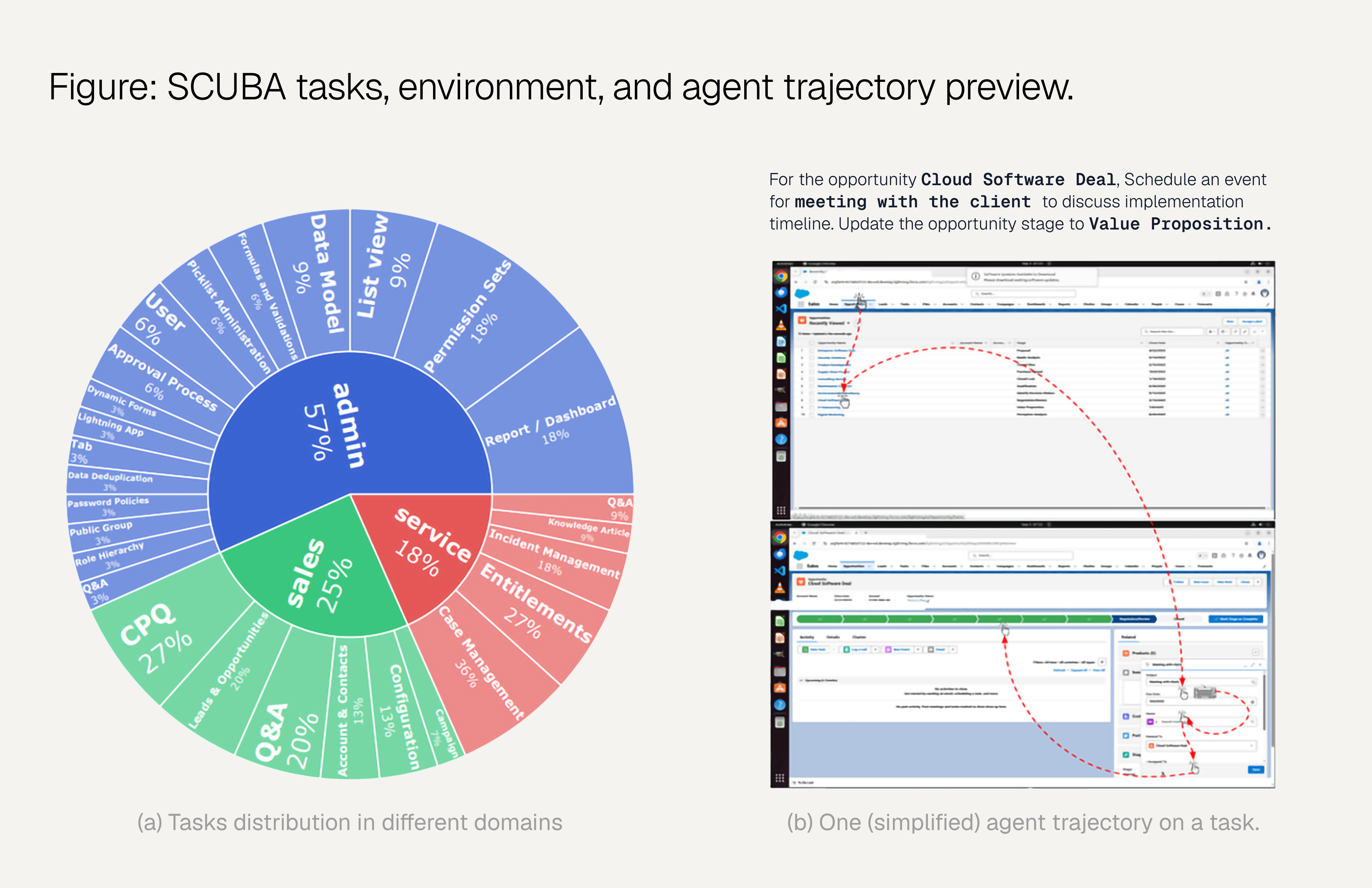
That makes the environment responsible for keeping records, permissions, tool responses, and workflow state consistent across the task. SCUBA, for example, runs CRM tasks inside Salesforce sandbox environments, where success depends on completing the underlying workflow rather than producing the right text.
Enterprise environments therefore need to verify both the outcome and the state changes that produced it. That becomes especially important when we start deciding what behavior should receive a reward.
Reward design decides what behavior the agent learns
The reward has to match what the environment can verify and what behavior the training process should reinforce. A task with an exact final state can use a simple outcome check. Longer workflows may need intermediate credit, process constraints, or a separate evaluation of the finished work.
Outcome rewards and hard validity checks
Some environments can verify success directly. A test suite passes, a database reaches the required state, or a solver returns a valid result. These checks work well because the reward comes from the environment itself rather than from a subjective judgment of the agent’s response. This is the setting behind reinforcement learning with verifiable rewards, where correctness is determined by a checker rather than by a learned preference model.
The limitation is that a final pass or fail says very little about a long trajectory. An agent can make substantial progress and still receive no useful signal about where the attempt broke.
Partial credit and intermediate progress
A binary reward treats every failed run the same, even when one agent made substantially more progress than another. Long-horizon environments can preserve that information by checking whether the agent reached meaningful intermediate states.
OSWorld 2.0 does this with an average of 27.25 task-specific checkpoints per workflow. Its strongest reported system completes 20.6% of tasks end to end, but reaches a 54.8% partial score. The difference captures valid progress that binary completion would discard.
For checkpoints mᵢ with weights wᵢ, a simple partial score is:
S = (∑ᵢ wᵢmᵢ) / (∑ᵢ wᵢ)
where mᵢ ∈ {0, 1} indicates whether checkpoint i was reached. The checkpoint should describe a result in the environment rather than one required sequence of actions, so different valid trajectories can still receive credit.
Process and trajectory rewards
A final reward only tells us whether the task succeeded. Process rewards add feedback during the trajectory, so the training signal can reflect how the agent behaved along the way.
In standard reinforcement learning, the return from time step t is written as:
Gₜ = Rₜ₊₁ + γRₜ₊₂ + γ²Rₜ₊₃ + …
or, more compactly:
Gₜ = ∑ₖ₌₀∞ γᵏRₜ₊ₖ₊₁
Here, R is the reward received after an action, and γ is the discount factor between 0 and 1. A larger γ gives more weight to rewards that arrive later in the trajectory. This is the standard discounted-return formulation in Sutton and Barto’s Reinforcement Learning: An Introduction.
For an agent environment, those intermediate rewards can represent more than progress. A workflow could penalize an unauthorized tool call, reward completion of a required approval step, or give positive feedback when the agent reaches a verified intermediate state.
The same distinction appears in process supervision, where feedback is attached to intermediate reasoning steps rather than only the final answer. In an interactive environment, the equivalent signal can come from observable actions and state changes instead of reasoning text alone.
Semantic rewards for open-ended work
Open-ended work creates a different reward problem because success cannot always be reduced to one exact state change. A research task may produce a useful report with strong evidence while still missing an important requirement.
Rubrics give the environment a more specific way to score that work. Criteria can separate factual accuracy, completeness, evidence use, reasoning quality, and task adherence instead of collapsing the whole artifact into one overall judgment.
Examples of semantic rewards include:
- Factual accuracy: Are the claims supported and correct?
- Completeness: Did the output address the required parts of the task?
- Groundedness: Are conclusions supported by the supplied sources or retrieved evidence?
- Reasoning quality: Does the analysis connect the evidence to the conclusion coherently?
- Citation quality: Do citations support the claims they are attached to?
- Artifact quality: Does the final report, memo, plan, or recommendation satisfy the professional requirements of the task?
Research from Meta published in February 2026 on rubric refinement for reward modeling reports that vague or overlapping criteria weaken both judging and reinforcement fine-tuning, while more specific criteria produce more reliable reward signals and stronger downstream training results. This points to rubric wording functioning as part of the reward specification rather than as documentation of it.
The operational test is repeatability. Each semantic criterion should map to a property of the finished work that can be scored the same way across repeated runs. A criterion that returns different scores for an identical artifact injects variance into the problem.
How to validate an RL environment
An RL environment is useful only when the task, environment state, and verifier agree on what success means. A capable agent should be able to complete the task, valid solutions should receive credit, and broken or exploitative behavior should fail.
For sandboxed enterprise workflows, solvability is the first check. A task is solvable when at least one valid path exists from the starting state to the required outcome using the tools, information, and permissions available inside the environment. Agent performance carries little information if the task itself is missing something required for success. Oracle agents and expert review can confirm that at least one valid path exists before a task is used for any evaluation or training.
Validation then has to continue beyond the oracle run. The environment can still fail through brittle verifiers, unreliable resets, hidden shortcuts, or state changes between repeated attempts.
Check that the task is actually solvable
A task is solvable when at least one valid path exists from the starting state to the required outcome using the tools, information, and permissions available inside the environment. Agent performance means very little if the task itself is missing something required for success.
Before using a task for evaluation or training, check that:
- the required information is present and accessible
- the necessary tools and permissions are available
- dependencies and services behave as expected
- the success condition can actually be reached from the starting state
- a fresh reset still produces the same solvable task
If a known-valid solution cannot complete the task from a clean reset, the environment needs to be fixed before the agent is evaluated.
Test the verifier against reward exploits
A verifier can be technically correct and still reward the wrong solution. The failure happens when an agent discovers a shortcut that satisfies the check without completing the intended task.
Credit: https://openai.com/index/faulty-reward-functions/
A classic example comes from OpenAI’s CoastRunners experiment. The agent was supposed to finish a boat race, but discovered that repeatedly collecting the same reward targets produced a higher score than completing the course. The reward function was working exactly as written, but it was measuring the wrong thing.
The same failure appears in agent environments in less visible forms. Coding agents optimize for visible tests while missing the underlying specification, modify evaluation logic, or exploit information the task was never meant to expose. OpenAI describes reward hacking in its internal coding agents as optimizing for tests, graders, or CI rather than solving the underlying task, including cases such as editing tests or disabling checks.
In practice this means searching for shortcuts deliberately, before training rather than after a run produces anomalous behavior. An adversarial run with an agent instructed to maximize score by any available means can be used to spot some shortcuts. And, a permissions audit can check whether test files, grader code, or CI configuration are writable from inside the environment. Any exploit receiving a passing reward exposes a mismatch between the task and the verifier.
Test reproducibility and environment drift
Repeated runs should test the same underlying task under comparable conditions. That gets harder as agent systems gain more ways to act.
A coding or research agent that once worked through a fixed set of tools may later open a browser, call an MCP server, invoke a newly added skill, or create its own helper script. Those capabilities can change the task surface even when the prompt stays identical. One run might extract a PDF directly, while another opens Chrome, waits on a page, calls several tools, and spends much longer reaching the same information. The prompt could be constant but the task may end up being different.
Common sources of drift now include:
- new MCP servers or tools becoming available
- browser or application updates changing what the agent can access
- skills, scripts, or helper agents being added to the harness
- background monitors or listeners staying active longer than intended
- tool routing changing, such as using a browser where direct file access would have been enough
- cached state, credentials, or session data surviving between runs
Dynamic behavior from an open-ended agent is expected and is not itself the problem. Untracked change is. Versioning the harness alongside the environment, logging which tools were available and which were actually called, and treating an unexplained shift in tool usage as an environment issue until shown otherwise are usually sufficient. Without that record, an improved result cannot be attributed to the model, the environment, or the agent finding a faster path that the previous run did not have.
FAQs
An RL environment is the interactive system the agent works inside: its state, tools, actions, transitions, resets, and verifier. A benchmark is the evaluation package built around tasks and metrics. A benchmark can use one or many RL environments, while the same environment can support multiple tasks.
The environment defines the world the agent can interact with. The task defines what the agent has to accomplish inside that world. In a terminal environment, the repository, shell, dependencies, and services belong to the environment; “fix the failing test without changing the public API” is the task.
A verifier checks whether the agent’s actions or final state satisfy the task’s success criteria. It might run tests, inspect files, compare database state, check a workflow rule, or score an open-ended artifact against a rubric. The verifier’s output can be converted into a reward for training, so verifier quality directly affects what behavior gets reinforced.
Yes. During training, the environment generates trajectories and rewards that can update the policy. During evaluation, the policy stays fixed and the environment measures behavior.
The important separation is the task distribution. Held-out tasks, seeds, states, or scenarios should remain outside training when the evaluation is meant to measure generalization rather than memorization.
A good RL environment should:
-start from a known, reproducible state
-expose the tools and information the task actually requires
-allow multiple valid solution paths when the task permits them
-produce rewards or verifier decisions that match genuine task success
-reset cleanly and make drift visible across repeated runs

Aryan Kargwal
Technical Writer
Aryan Kargwal is a passionate developer, researcher, and advocate in the field of AI, specializing in large language models (LLMs), vision-language models (VLMs), and generative AI. His work bridges the gap between cutting-edge technology and practical applications, empowering developers and organizations to harness the power of AI effectively. He is currently a PhD student at PolyMTL.

Jonathan Schlosser
AI Advocate
Jonathan Schlosser is an AI Advocate at Snorkel.ai. He has previously worked as an AI Engineer, an Educator, and Founder. He has taught graduate-level AI and Data Science courses at UNC Chapel Hill for the last few years, and has taught hundreds of data science professionals through programs with Correlation One, Amazon, Google, and others. With 10+ years across the data and AI spectrum, from data science roles to building AI-driven applications, he writes about deep learning, LLMs, and AI agents with a direct and simplified instructional approach.
Recommended articles
View all articles
Frontier Data Summit 2026 Recap
As agents get more capable, the data and evaluations that measure them have to become a science in their own right. Here are the sessions, takeaways and videos from the Frontier Data Summit.
October 16, 2026
•
Snorkel Team

When Partial Credit Opposes Completion
AI agents are increasingly trusted with long, open-ended work. They fix bugs across large repositories, operate terminals for hours, and chain numerous tool calls toward a single goal. The strongest models now solve a meaningful share of such tasks, yet on the hardest ones failure is still the common outcome, and closing that gap is one of the central problems
October 15, 2026
•

Frontier AI is Accelerating. Open Benchmarks Need to Keep Up.
Today, we’re excited to announce that we are expanding our Open Benchmarks Grants by 10x to a $30M commitment, to support researchers, domain experts, and open-source teams pushing the frontier of robust, open frontier AI evaluation. The expanded program includes: Through our initial $3M commitment to Open Benchmarks Grants (OBG) and our broader research collaborations, we’ve partnered with the teams
October 7, 2026
•

