Tag

Data Development

Data development encompasses the processes of curating, organizing, and preparing datasets for use in machine learning and AI projects. This includes data sourcing, cleaning, labeling, and augmenting, ensuring that the data used is high-quality and relevant. Data-centric approaches prioritize the value of data itself, often leading to more reliable and efficient model outcomes.
All articles on Data Development

Image
Introducing Continuous Model Feedback to drive rapid data quality improvement
Continuous Model Feedback, available in beta as part of the new Studio experience, is Snorkel Flow’s latest capabilities to make training data creation and model development more integrated, automated, and guided.
August 29, 2022
Molly Friederich
Image
The Future of Data-Centric AI 2022 day 2 highlights
Snorkel AI just hosted the second day of The Future of Data-Centric AI conference 2022. Across 40+ sessions, 50+ Data scientists, ML engineers, and AI leaders came together to share insights, best practices, and research on adopting data-centric approaches with thousands of attendees from all around the world. Aarti Bagul, a Snorkel AI ML Solutions Engineer and one of the
August 5, 2022
Louis Bouchard
Image
The Future of Data-Centric AI 2022 day 1 highlights
Snorkel AI just hosted the first day of The Future of Data-Centric AI conference 2022. This conference brings together data scientists, ML engineers, and AI leaders to share insights, best practices, and research on how to evolve the ML lifecycle from model-centric to data-centric approaches. This conference takes place over two days with 40+ sessions, 50+ speakers, and thousands of
August 4, 2022
Louis Bouchard
Image
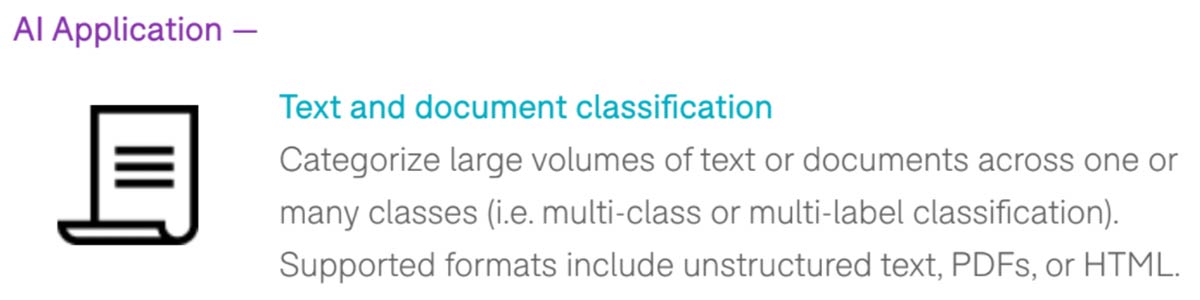
Data-centric approaches to multi-label classification
AI systems are well-suited to tasks involving recognizing and predicting data patterns. Supervised classification systems categorize unseen data into a finite set of discrete classes by learning from millions of hand-labeled labeled sample points. These classifiers are powerful business tools – they automate document sorting, customer sentiment analysis, sales performance, and other distinct business problems. However, they also require an
June 29, 2022
Kanyes Thaker
Image
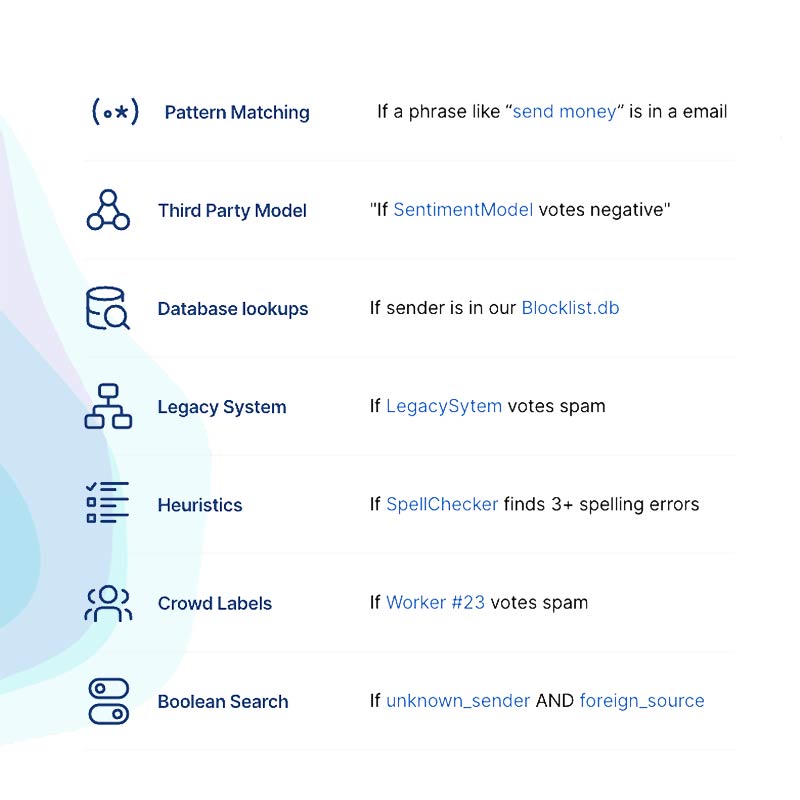
3 ways to use Snorkel’s Labeling Functions
Labeling functions are fundamental building blocks of programmatic labeling that encode diverse sources of weak labeling signals to produce high-quality labeled data at scale. Let’s start with the core motivation for labeling functions: over time, every major commercial organization and government agency builds various valuable, often bespoke knowledge resources. These resources include employee expertise, wikis and ontologies, business logic, and
June 24, 2022
Nic Acton
Image
Building AI models for financial document processing best practices
Highlighting the best practices for building and deploying AI models for financial document processing applications AI has massive potential in the financial industry. Building AI models to automate information extraction, fraud detection, and compliance monitoring can provide efficient and faster responses and support repurposing domain experts’ labor to more meaningful tasks. Developing AI models is not just about having models
June 15, 2022
Hoang Tran
Trustworthy AI, image by Tara Winstead
The benefits of programmatic labeling for trustworthy AI
The following post is based on a talk discussing the benefits of programmatic labeling for trustworthy AI, which was presented as part of the Trustworthy AI: A Practical Roadmap for Government event that took place this past April, with Snorkel AI Co-founder and Head of Technology, Braden Hancock. If you would like to watch Braden’s presentation, we have included it
June 9, 2022
Team Snorkel
Image
Government keynote presentation by FBI CTO Gregory Ihrie
Gregory Ihrie is the Chief Technology Officer for the FBI, responsible for technology, innovation, and strategy. He also leads the FBI’s efforts in advancing the bureau’s management, policy, and governance of AI systems. Ihrie chairs the FBI’s Scientific Working Group on Artificial Intelligence, as well as the Department of Justice’s AI Committee of Interest. He is one of three officers
June 4, 2022
Team Snorkel
Ce Zhang portrayed
MLOps: Towards DevOps for data-centric AI with Ce Zhang
The future of data-centric AI talk series  Don’t miss the opportunity to gain an in-depth understanding of data-centric AI and learn best practices from real-world implementations. Connect with fellow data scientists, machine learning engineers, and AI leaders from academia and industry with over 30 virtual sessions. Save your seat at The Future of Data-Centric AI. Happening on August 3-4, 2022.
June 2, 2022
Team Snorkel
The future of data-centric AI presented by Snorkel AI
What to expect at The Future of Data-Centric AI 2022
30+ sessions by 40+ speakers in 2 action-packed days Last year we organized The Future of Data-Centric AI conference to explore the shift from model-centric to data-centric AI. Speakers included researchers and industry experts such as Andrew Ng (Landing AI), Anima Anandkumar (NVIDIA), Chris Re (Stanford AI Lab), Michael DAndrea (Genentech), Skip McCormick (BNY Mellon), Imen Grida Ben Yahia (Orange)
June 1, 2022
Devang Sachdev
Image
Building a COVID fact-checking system with external knowledge
Powerful resources to leverage as labeling functions In this post, we’ll use the COVID-FACT dataset to demonstrate how to use existing resources as labeling functions (LFs), to build a fact-checking system. The COVID-FACT dataset contains 4086 claims about the COVID-19 pandemic; it contains claims, evidence for the claims, and contradictory claims refuted by the evidence. The evidence retrieval is formulated
May 26, 2022
Annie Yang
Image
Panel discussion: Academic and industry perspectives on ethical AI
This post showcases a panel discussion on the academic and industry perspectives of ethical AI, which was moderated by Director of Federal Strategy and Growth, Alexis Zumwalt, Fouts Family Early Career Professor and Lead of Ethical AI (NSF AI Institute AI4OPT), Georgia Institute of Technology, Swati Gupta, Chief Data Officer, Department of the Navy, Thomas Sasalsa, Senior Manager of Responsible
May 24, 2022
Team Snorkel
Image
Weak supervision
The founding team of Snorkel AI has spent over half a decade—first at the Stanford AI Lab and now at Snorkel AI—researching weak supervision (WS) and other techniques for breaking through the biggest bottleneck in AI: the lack of labeled training data. This research has resulted in the Snorkel research project and 150+ peer-reviewed publications. Snorkel’s technology which applies weak
May 17, 2022
Team Snorkel
Image
Data-centric AI: A complete primer
The founding team of Snorkel AI has spent over half a decade—first at the Stanford AI Lab and now at Snorkel AI—researching data-centric techniques to overcome the biggest bottleneck in AI: The lack of labeled training data. In this video Snorkel AI co-founder Paroma Varma gives an overview of the key principles of data-centric AI development. What is data-centric AI?
May 17, 2022
Team Snorkel
Data extraction from SEC filings (10-Ks) with Snorkel Flow
Leveraging Snorkel Flow to extract critical data from annual quarterly reports (10-Ks) Introduction It can surprise those who have never logged into EDGAR how much information is available in annual reports from public companies. You can find tactical details like the names of senior leadership, top shareholders, and more strategic information like earnings, risk factors, and the company strategy and vision. Warren
May 10, 2022
Jonathan Dahlberg
Image
Accelerating AI in healthcare
How can data-centric AI speeds your end-to-end healthcare AI development and deployment Healthcare is a field that is awash in data, and managing it all is complicated and expensive. As an industry, it benefits tremendously from the ongoing development of machine learning and data-centric AI. The potential benefits of AI integration in healthcare can be broken down into two categories:
April 29, 2022
Team Snorkel
Image
Bill of materials for responsible AI: collaborative labeling
In our previous posts, we discussed how explainable AI is crucial to ensure the transparency and auditability of your AI deployments and how trustworthy AI adoption and its successful integration into our country’s critical infrastructure and systems are paramount. In this post, we dive into making trustworthy and responsible AI possible with Snorkel Flow, the data-centric AI platform for government and federal agencies. Collaborative labeling and
April 28, 2022
Alexis Zumwalt
Image
ICLR 2022 recap from Snorkel AI
We are honored to be part of the International Conference on Learning Representations (ICLR) 2022, where Snorkel AI founders and researchers will be presenting five papers on data-centric AI topics The field of artificial intelligence moves fast!  This is a world we are intimately familiar with at Snorkel AI, having spun out of academia in 2019. For over half a
April 20, 2022
Braden Hancock
Image
Spring 2022 Snorkel Flow release roundup
Latest features and platform improvements for Snorkel Flow 2022 is off to a strong start as we continue to make the benefits of data-centric AI more accessible to the enterprise. With this release, we’re further empowering AI/ML teams to drive rapid, analysis-driven training data iteration and development. Improvements include streamlined data exploration and programmatic labeling workflows, integrated active learning and AutoML,
April 14, 2022
Molly Friederich
Image
Weak Supervision Modeling with Fred Sala
Understanding the label model. Machine learning whiteboard (MLW) open-source series Background Frederic Sala, is an assistant professor at the University of Wisconsin-Madison, and a research scientist at Snorkel AI. Previously, he was a postdoc in Chris Re’s lab at Stanford. His research focuses on data-driven systems and weak supervision. In this talk, Fred focuses on weak supervision modeling. This machine
March 17, 2022
Team Snorkel
Image
Tips for using a data-centric AI approach
The future of data-centric AI talk series Background An AI system consists of two parts: the model— algorithm or some code—and data. The dominant paradigm in machine-learning researchers has been for most data scientists, including myself, to download a fixed dataset and iterate on the model. That this has become conventional is a tribute to how successful this model-centric approach
March 9, 2022
Team Snorkel
Image
Resilient enterprise AI application development
Using a data-centric approach to capture the best of rule-based systems and ML models for enterprise AI One of the biggest challenges to making AI practical for the enterprise is keeping the AI application relevant (and therefore valuable) in the face of ever-changing input data and evolving business objectives. Practitioners typically use one of two approaches to build these AI applications:
March 3, 2022
Arjun Prakash
Augmenting the clinical trial design process with information extraction
The future of data-centric AI talk series Background Michael DAndrea is the Principal Data Scientist at Genentech. He earned his MBA from Cornell University and a Master’s degree in Computing and Education from Columbia University. He currently works on using unstructured data sources for clinical trial analytics and his team is partnered with the Stanford “AI For Health” initiative as
February 22, 2022
Team Snorkel
Q4 LTS Release of Snorkel Flow
We’re excited to announce the Q4 2021 LTS release of Snorkel Flow, our data-centric AI development platform powered by programmatic labeling. This latest release introduces a number of new product capabilities and enhancements, from a streamlined programmatic data development interface, to enhanced auto-suggest for labeling functions, to new machine learning capabilities like AutoML, to significant performance enhancements for PDF data
February 8, 2022
Henry Ehrenberg
Image
The Principles of Data-Centric AI Development
The Future of Data-Centric AI Talk Series Background Alex Ratner is CEO and co-founder of Snorkel AI and an Assistant Professor of Computer Science at the University of Washington. He recently joined the Future of Data-Centric AI event, where he presented the principles of data-centric AI and where it’s headed. If you would like to watch his presentation in full,
January 25, 2022
Team Snorkel
Advancing Snorkel from research to production
The Snorkel AI founding team started the Snorkel Research Project at Stanford AI Lab in 2015, where we set out to explore a higher-level interface to machine learning through training data. This project was sponsored by Google, Intel, DARPA, and several other leading organizations and the research was represented in over 40 academic conferences such as ACL, NeurIPS, Nature and
January 18, 2022
Team Snorkel
Building AI Applications Collaboratively Using Data-centric AI
The Future of Data-Centric AI Talk Series Background Roshni Malani received her PhD in Software Engineering from the University of California, San Diego, and has previously worked on Siri at Apple and as a founding engineer for Google Photos. She gave a presentation at the Future of Data-Centric AI virtual conference in September 2021. Her presentation is below, lightly edited
January 14, 2022
Team Snorkel
Artificial Intelligence (AI) Facts and Myths
ScienceTalks with Abigail See. Diving into the misconceptions of AI, the challenges of natural language generation (NLG), and the path to large-scale NLG deployment In this episode of Science Talks, Snorkel AI’s Braden Hancock chats with Abigail See, an expert natural language processing (NLP) researcher and educator from Stanford University. We discuss Abigail’s path into machine learning (ML), her previous
November 23, 2021
Team Snorkel
Design Principles for Iteratively Building AI Applications
Enabling iterative development workflows with Snorkel Flow’s Application Studio. Consider this scenario— we’re AI engineers, and we’re building a social media monitoring application to track the sentiment of Fortune 500 company mentions in the news.
November 8, 2021
Vincent Sunn Chen
Snorkel’s Journey to Data-Centric AI, with Chris Ré
The Future of Data-Centric AI Talk Series Background Snorkel co-founder Chris Ré is an associate professor of Computer Science at Stanford University and an award-winning researcher in data-based theory and machine learning. He has co-founded four companies based on his research in machine learning systems. Chris recently presented at the Future of Data-Centric AI virtual event in September, where he
November 3, 2021
Team Snorkel