


author
Principal Research Scientist
,
Snorkel AI
(opens in a new tab)
(opens in a new tab)
(opens in a new tab)
(opens in a new tab)
(opens in a new tab)
Mehdi Fatemi is a Principal Research Scientist at Snorkel AI and a reinforcement learning (RL) researcher with more than 15 years of experience, beginning with his PhD at McMaster University. His work spans the foundations and applications of RL, including value-based methods, long-horizon and multi-turn decision-making, and, over the past few years, reasoning in large language models under diverse feedback signals and uncertainty. Previously, during several years at Microsoft Research, he made numerous core contributions to RL through papers, patents, and public releases, including Hybrid Reward Architecture for learning from decomposable rewards and dead-end theory for identifying and avoiding irrecoverable states. His recent work includes Concise Reasoning, which shows that RL’s loss alone drives reasoning models toward verbosity or conciseness, depending on the solvability of the training tasks.
The latest from Mehdi Fatemi
Blog
NEW
Training agents for professional work when success is rare
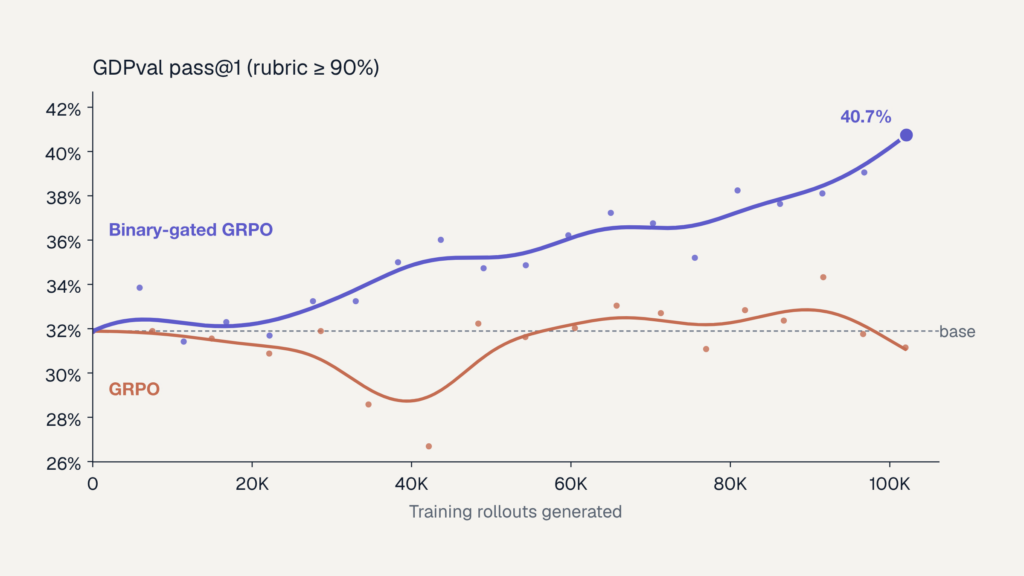
We trained Qwen3.8-27B on 1,105 professional tasks from Snorkel’s GDPval+ series. After about 102K training rollouts, the model reaches 40.7% pass@1 on OpenAI’s GDPval gold set, up from 31.9%. Its deliverables now beat those of human experts in 44.0% of LLM-judged head-to-head comparisons, compared with 36.4% for the base model. The gains come from two ingredients working together, expert-built training…

Blog
When Partial Credit Opposes Completion
AI agents are increasingly trusted with long, open-ended work. They fix bugs across large repositories, operate terminals for hours, and chain numerous tool calls toward a single goal. The strongest models now solve a meaningful share of such tasks, yet on the hardest ones failure is still the common outcome, and closing that gap is one of the central problems…

