


Research
November 4, 2026
•
10 min read
•
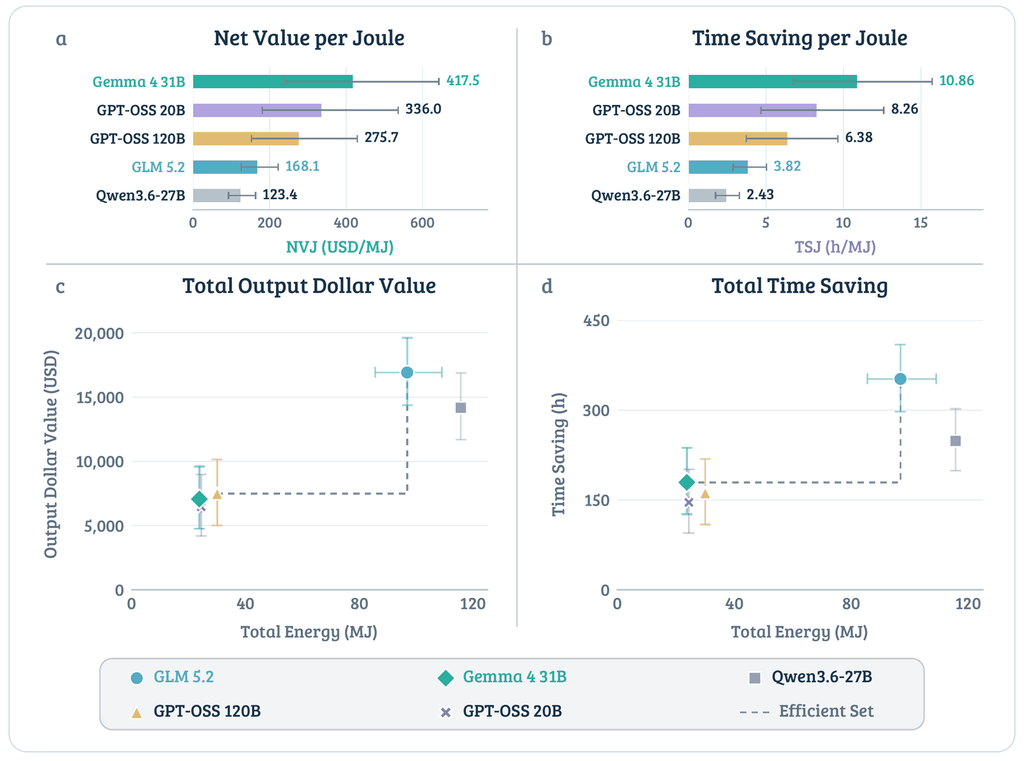
The model that produces the most valuable work isn’t always the best use of your energy. This is one of the interesting findings in Joules-to-GDP, a paper released today by researchers at Stanford, UC Berkeley and UT Austin. Of the five models they tested, GLM 5.2 delivered the most net value per task, but Gemma 4 31B delivered 56% of that value on 23% of the energy, about 2.5 times the net value per joule.
Our research team provided expert baselines for the 220 GDPval tasks used in the study and partnered to develop GDPWorks, 83 new tasks covering 36 occupations that GDPval doesn’t include.
Read the paper · Get the dataset
Key findings
- The most valuable model isn’t the most efficient one. Gemma 4 31B produced 44% less output value than GLM 5.2, but it returned the most net value per unit of energy of the five models. (Net value is the dollar value of the AI’s work minus what it cost to run.)
- Energy shows differences that cost and speed hide. GPT-OSS 120B and GLM 5.2 had nearly the same cost and speed (GPT-OSS 120B cost about 3.1% more and finished about 2.1% faster), but GPT-OSS 120B used 68% less energy.
- Hardware matters, even for the same model. Running the same model, Qwen3.6-27B, on an NVIDIA B200 returned $535.5 of net value per megajoule of energy, compared with $124.1 on an AMD MI350X.
- More GPUs and more retries cost more energy than they return. Running a model on eight H100 GPUs instead of one made it only 22% faster, while using 3.24 times the energy.
- Experts who use AI set a higher bar. When GLM 5.2’s work was judged against experts who used AI, instead of experts working alone, its net value per unit of energy fell 70%.
- Energy changes which work looks most valuable. Architecture and engineering tasks produced about 10% more net value per task than software development, but software development produced about 27% more per joule.
More value per task doesn’t mean more value per joule
| Model | Output value (USD/task) | Execution cost (USD/task) | Energy (MJ/task) | NVJ (USD/MJ) | TSJ (hours/MJ) |
|---|---|---|---|---|---|
| GLM 5.2 | 74.19 | 1.92 | 0.430 | 168.1 | 3.82 |
| Qwen3.6-27B | 67.81 | 4.12 | 0.516 | 123.4 | 2.43 |
| Gemma 4 31B | 41.38 | 0.86 | 0.097 | 417.5 | 10.86 |
| GPT-OSS 120B | 39.73 | 1.98 | 0.137 | 275.7 | 6.38 |
| GPT-OSS 20B | 35.88 | 1.12 | 0.103 | 336.0 | 8.26 |
Table 1. Results for five models, each given one attempt per task and compared with experts working alone. Values are GDP-weighted averages per task. NVJ is net value per megajoule (MJ) of energy, in US dollars, and TSJ is expert time saved per megajoule, in hours (Zeinali et al., 2026).
GLM 5.2 produced the most output value, $74.19 per task, using 0.430 MJ, about the energy of four hours of active laptop use. Gemma 4 31B led on both net value and time saving per joule. That doesn’t mean the smaller model always wins. A model with a high return per joule can still finish too little of the work, which is why the paper reports total value alongside the per-joule numbers.
GLM 5.2 ran on eight H200s because its FP8 serving setup didn’t fit on the eight-H100 node used for the other four models, so its numbers reflect both the model and the hardware.
Models with similar cost and speed can use very different amounts of energy
GPT-OSS 120B and GLM 5.2 had nearly the same cost and speed (GPT-OSS 120B cost about 3.1% more and finished about 2.1% faster), but GPT-OSS 120B used 68% less energy. Which measure you use changes the winner. GLM 5.2 delivered more net value per dollar of AI cost (37.69 vs 19.09) and per AI hour ($191.3 vs $102.1), while GPT-OSS 120B delivered more per megajoule (275.7 vs 168.1 USD/MJ).
Hardware choice changes the return per joule
| Accelerator | Net value per megajoule (NVJ, USD/MJ) | Time saving per megajoule (TSJ, hours/MJ) |
|---|---|---|
| NVIDIA B200 | 535.5 | 11.684 |
| NVIDIA H200 | 391.3 | 7.293 |
| NVIDIA H100 | 402.2 | 7.243 |
| AMD MI350X | 124.1 | 1.260 |
Table 2. Net value and expert time saved per megajoule when Qwen3.6-27B runs on a single accelerator, compared with experts working alone (Zeinali et al., 2026).
Running the same model, Qwen3.6-27B, on four chips with identical settings gives a controlled test of the hardware. The NVIDIA B200 came out on top on both metrics, and the AMD MI350X came last. The paper points to differences in chip design, memory bandwidth and power draw to help explain the spread. Because energy is measured across the whole run, including time spent waiting on tool calls, a chip’s energy use depends both on how much power it draws and on how long the work takes. The H200 and H100 came out about even (391.3 vs 402.2 USD/MJ), so the newer chip wasn’t automatically better.
Extra GPUs and retries don’t pay for their energy
Moving Qwen3.6-27B from one H100 to eight made it only 22% faster, while using 3.24 times the energy, with output value about the same ($64.79 vs $67.81 per task). Net value per joule fell from 402.2 to 123.4 USD/MJ. Splitting the model across eight GPUs speeds up its own computation, but that’s only part of each task. The GPUs have to pass data back and forth and wait on each other, and the agent’s tool calls, like running code or editing files, happen one at a time no matter how many GPUs there are. So tasks finished only 22% faster, while all eight GPUs drew power for the entire run, including while they waited.
Retries showed the same pattern. With four attempts per task, GLM 5.2’s output value rose from $74.19 to $93.42, but energy went from 0.430 to 1.760 MJ and net value per joule fell from 168.1 to 48.6 USD/MJ. In this test, all four attempts ran and counted toward energy use, even when an earlier attempt had already succeeded. A system that stops once it gets a good answer would use less energy, and the paper didn’t test that.
AI-assisted experts are harder to beat
Every result above compares the AI with experts who worked alone. The paper also compared the same GLM 5.2 outputs against experts who worked with AI, which is closer to how many professionals work today. Scored against these AI-assisted experts instead, GLM 5.2’s net value fell 70%, from $168.1 to $50.0 per megajoule of energy. Two things caused the drop. First, the AI-assisted experts set a higher bar. GLM 5.2 cleared it about half as often as it cleared the bar set by experts working alone. Second, the AI-assisted experts were faster, spending about 23% less time on average, so there was less expert time for the AI to save. On the tasks where GLM 5.2 did match the AI-assisted experts, it finished about 84% faster than they did.
Energy reshuffles which work looks most valuable
Architecture and Engineering tasks produced about 10% more net value per task than Computer and Mathematical tasks, but Computer and Mathematical tasks produced about 27% more per joule. But these rankings are based on a small number of tasks. Each occupation has only five tasks, and some categories contain a single occupation: Computer and Mathematical, for example, is just software developers. When the authors removed one task from each category at random across 10,000 trials, Computer and Mathematical stayed first on net value per joule in 76.5% of them.
How it works
Net Value per Joule (NVJ) is the dollar value of an AI output, minus the cost of running the AI system, divided by the energy used. Time Saving per Joule (TSJ) is the expert time saved divided by the same energy. A judge model, Gemini 3.1 Flash-Lite, compares each AI output with an expert’s deliverable without knowing which is which. If the judge rates the AI’s output as a win or a tie, the AI is credited with that task’s dollar value: the time the expert took to do it, multiplied by the median hourly wage for that occupation. If it loses, it gets no credit, but its cost and energy still count. Energy covers GPU, CPU and memory over the whole run, measured with Intelligence per Watt, and results are weighted by each sector’s share of U.S. GDP and each occupation’s share of employment within its sector. See the paper for full details, including how energy is measured and how results are weighted.
What Snorkel contributed
Both NVJ and TSJ are measured against an expert’s finished work and the time the expert took to do it. Snorkel provided that expert data. Each of the 220 GDPval tasks was completed twice, by two different experts: once without AI and once with AI assistance. Experts in the AI-assisted condition used Claude through the Claude web chat interface.
We also built GDPWorks, 83 new tasks for testing whether the findings hold for more occupations and longer workflows. It adds 36 O*NET occupations that aren’t in GDPval, such as bioinformatics scientists and purchasing managers, for 80 occupation codes in total. The tasks are more demanding. The median expert-only time estimate is 4.0 hours, compared with 2.34 hours for GDPval, and the median task has six reference files instead of one. GDPWorks wasn’t used for the paper’s results, which come from the 220 GDPval tasks. It’s in the dataset release so others can run that test.
This work is also supported by Open Benchmarks Grants.
Limitations
- Value is estimated, not measured. Following GDPval, the dollar value of a task is the expert’s time multiplied by the occupation’s median wage. That isn’t measured GDP or the savings a real deployment would see.
- Limited scope. The study tested five open-weight models, which the researchers ran themselves rather than through an API so they could measure energy directly. It also covered only four types of chips, one agent framework (OpenHands) and five tasks per occupation, so the results may not hold for other setups.
- An automated judge. An AI model decided whether each output matched the expert’s. Across 32 randomly selected tasks out of the 220, human experts agreed with its call 71.9% of the time. That’s a small sample, but it’s in line with how often people agree with each other on similar judgments: the paper cites 64.7% from another study.
- What energy and cost leave out. Energy covers the GPUs, CPU and memory, but not the facility’s overhead. Cost excludes expert review, coordination and adoption.
Read more
- Paper: Joules-to-GDP, arXiv:2610.30858
- Dataset, with GDPWorks in the
joules_to_gdpsplit: huggingface.co/datasets/ScalingIntelligence/joules-to-gdp - Code: github.com/HazyResearch/joules_to_gdp
- Join the Snorkel Reading Group this Wednesday (11/4) in SF to hear from the authors: https://luma.com/41dbkzu4
Building evaluations that need expert data like this? Come talk to us.
Joules-to-GDP is by Amirreza Zeinali, Jon Saad-Falcon, Avanika Narayan, Mersad Abbasi, Jonathan S. Hartley, John Hennessy, Christopher Ré and Azalia Mirhoseini (Stanford University, UC Berkeley and The University of Texas at Austin).
References
Patwardhan, T., Dias, R., Proehl, E., Kim, G., Wang, M., Watkins, O., Posada Fishman, S., Aljubeh, M., Thacker, P., Fauconnet, L., Kim, N. S., Chao, P., Miserendino, S., Chabot, G., Li, D., Sharman, M., Barr, A., Glaese, A., & Tworek, J. (2025). GDPval: Evaluating AI model performance on real-world economically valuable tasks. arXiv:2510.04374. https://arxiv.org/abs/2510.04374
Zeinali, A., Saad-Falcon, J., Narayan, A., Abbasi, M., Hartley, J. S., Hennessy, J., Ré, C., & Mirhoseini, A. (2026). Joules-to-GDP: How much economic value do AI systems produce per unit of energy? arXiv:2610.30858. https://arxiv.org/abs/2610.30858

Ramya Ramakrishnan
Applied Research Scientist
Ramya Ramakrishnan is a Staff Research Scientist at Snorkel AI.

Jonathan Schlosser
AI Advocate
Jonathan Schlosser is an AI Advocate at Snorkel.ai. He has previously worked as an AI Engineer, an Educator, and Founder. He has taught graduate-level AI and Data Science courses at UNC Chapel Hill for the last few years, and has taught hundreds of data science professionals through programs with Correlation One, Amazon, Google, and others. With 10+ years across the data and AI spectrum, from data science roles to building AI-driven applications, he writes about deep learning, LLMs, and AI agents with a direct and simplified instructional approach.
Recommended articles
View all articles

Checking the Rubrics: RIFT Results on Five Public Benchmarks
Rubric-based evaluation is now a common way to score the outputs of language models and agents (Hashemi et al., 2024; Wei et al., 2025), and rubrics also serve as the source of reward signals in training (Gunjal et al., 2025; Liu et al., 2026; Ding, 2026). In both uses the rubric is the measurement instrument, and the validity of any
November 2, 2026
•
,
,
,

Frontier Data Summit 2026 Recap
As agents get more capable, the data and evaluations that measure them have to become a science in their own right. Here are the sessions, takeaways and videos from the Frontier Data Summit.
October 16, 2026
•
Snorkel Team

When Partial Credit Opposes Completion
AI agents are increasingly trusted with long, open-ended work. They fix bugs across large repositories, operate terminals for hours, and chain numerous tool calls toward a single goal. The strongest models now solve a meaningful share of such tasks, yet on the hardest ones failure is still the common outcome, and closing that gap is one of the central problems
October 15, 2026
•

